
Charging Cables with Reinforced Ends That Last Forever

Introducing Maria, our meticulous planner and talented visual storyteller. She has a knack for discovering those hidden gems, chic boutique spots, and charming little cafes that add a touch of elegance to every journey. With her keen eye for photography and her passion for travel, Maria will transport you to the most enchanting corners of the world, inspiring you to explore new places, one picture-perfect destination at a time.
Looking for a cable that won’t snap after a thousand bends? Start with a laser‑welded, dual‑braided design like the AINOPE 6.6‑ft 60W or the 25‑ft charge‑only cable. Both use Kevlar or reinforced necks to keep strain off the connectors, and their 20 000‑plus bend tests mean they’ll last through everyday use. These models also support fast charging, so you stay powered. Curious about which one fits your setup? You’ll discover more options, for your needs, too.
Wichtigste Erkenntnisse
- Look for cables with laser‑welded, anodized nickel‑plated connectors to prevent cracking at stress points.
- Ensure the cable jacket is dual‑braided nylon and the core is Kevlar‑braided to handle 20,000–40,000 bend cycles.
- Reinforced connector necks and strain‑relief loops distribute bending forces evenly, protecting internal strands.
- Verify manufacturers report >20,000 plug‑cycle endurance or higher, indicating true long‑term durability.
- Choose cables with 18‑month or longer warranties; this signals confidence in longevity and quality.
10ft 2-Pack Universal 3-in-1 USB Cable
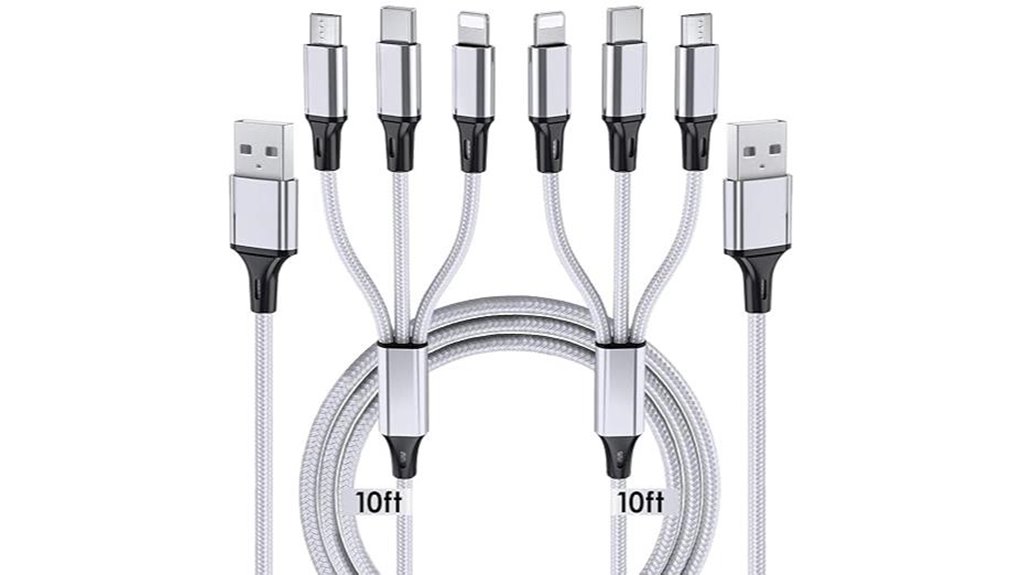
Looking for a long‑reach cable that won’t fray after a thousand twists?
Sure, this 10‑foot, 2‑pack set lets you jump straight to your phone, tablet, or Apple device without hunting for a separate cord. Each cable features a 3‑in‑1 design: USB‑C on one end, Micro‑USB on another, Lightning on the third, all bundled in one sheath that resists kinks and bends over 6,000 times. It stays tangle‑free, so you can charge from the sofa, bed, or car backseat while keeping the cord in your pocket. Weighing only 4.6 oz each, it’s lightweight and built to keep charging simple and reliable.
Best For: Travelers, commuters, and anyone who needs flexible and robust charging while on the go.
Pros:
- Versatile 3‑in‑1 design covers USB‑C, Micro‑USB, and Lightning, eliminating the need for multiple cords.
- Durable double‑braided nylon sheath rated for over 6,000 bends keeps the cable kink‑free and long‑lasting.
- 10‑foot reach means you can charge from the sofa, bedroom, or car seat without hunting for a power outlet.
Cons:
- Limited to 2 A 5 V output, so it doesn’t support fast charging on newer devices.
- The USB‑C connector’s 36‑pin design may not deliver higher currents or power delivery without an additional adapter.
- Two cables add bulk to a small bag or pocket compared to a single dedicated cord.
https://www.amazon.com/dp/B08P5M7YHB
10ft Multi USB Fast Charging Cable (4-in-1)
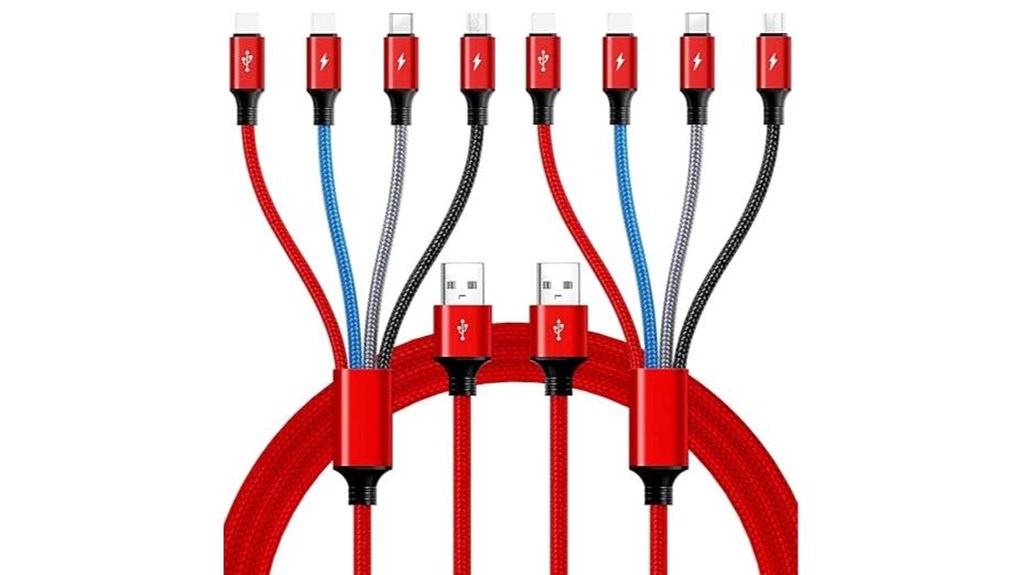
If you’re juggling an iPhone, an Android, and a laptop, this 10‑ft, 4‑in‑1 cable lets you power two devices at once—no more swapping cords.
You’ll appreciate its 10‑ft length and nylon‑braided jacket, giving you room to move and preventing tangles. The aluminum alloy core keeps the cable strong against daily wear. Dual 5 V/3 A outputs deliver up to 20 W each, ensuring fast charging for iPhones, iPads, and Androids. Lightning supports 480 Mbps data; USB‑C and Micro‑USB handle power only. The 2‑pack offers flexibility for two users or a backup. A 30‑day return, 12‑month warranty, and 24/7 support give peace of mind.
Best For: Individuals juggling an iPhone, an Android, and a laptop who need a single, tangle‑free cable to charge two devices simultaneously.
Pros:
- 10‑ft nylon‑braided length and aluminum alloy core for durability and tangle resistance.
- Dual 5 V/3 A outputs delivering up to 20 W each for fast charging on iPhones, iPads, and Androids.
- 2‑pack offering flexibility for multiple users or a backup cable.
Cons:
- USB‑C and Micro‑USB connectors provide power only; data transfer is limited to the Lightning port.
- Max power per side capped at 20 W—doesn’t support higher‑wattage fast charging (e.g., 65 W USB‑C).
- Requires a compatible 5 V/3 A source; may not charge as quickly from lower‑output adapters.
https://www.amazon.com/dp/B075L4TX9B
10ft C to C Charging Cable for iPhone
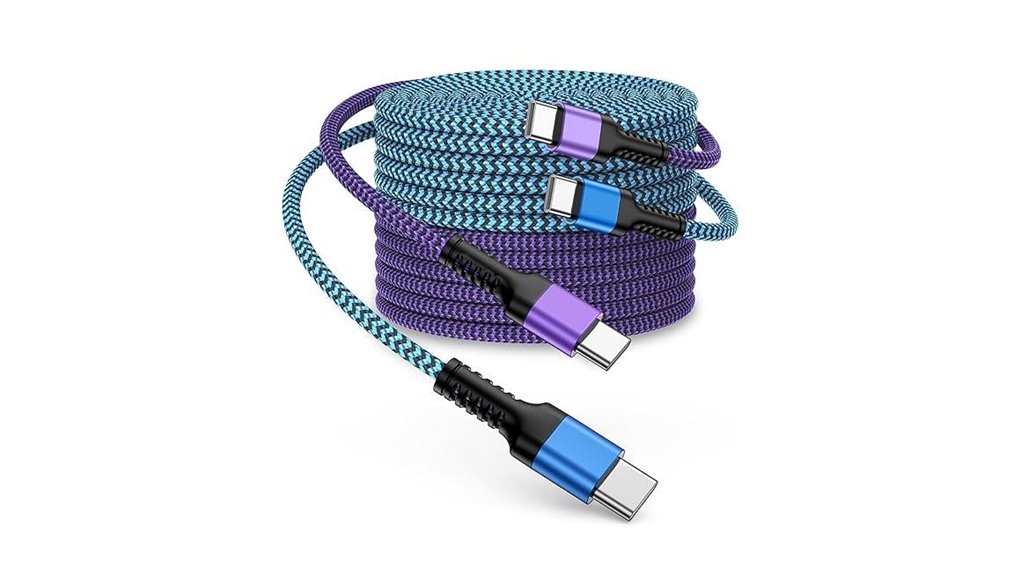
The 10‑foot USB‑C to USB‑C cable is the perfect choice for anyone who wants a reliable, fast‑charging solution that can stretch from a bedroom to a car seat. It plugs straight into any USB‑C device—iPhones 15‑17 Plus or Pro, iPads, Galaxy phones, Pixel models, and even USB‑C laptops—without adapters. The copper cable delivers up to 20 W fast charging, topping your iPhone from 0 % to 50 % in half an hour, while 480 Mbps keeps data transfers swift. Its premium nylon braid stays tangle‑free, and the aluminum housing resists heat, giving you a 20,000‑plus bend life that outlasts many rivals. For extra peace.
Best For: anyone needing a tough, fast‑charging USB‑C cable that can reach from a bedroom or car seat to a laptop or iPad.
Pros:
- Universal USB‑C to USB‑C compatibility—works with iPhones, iPads, Galaxy, Pixel, and any USB‑C laptop or tablet.
- 20 W fast charging (0 % → 50 % in 30 min) and 480 Mbps data transfer keep devices powered and files moved quickly.
- 20,000‑plus bend life with premium nylon braid and aluminum housing gives exceptional durability and heat resistance.
Cons:
- Requires USB‑C male‑to‑male; no USB‑A or Lightning adapters, limiting use with older devices.
- The extra‑long 10 ft length can be cumbersome in tight spaces.
- 20 W rating may not match 30 W/45 W fast‑charging limits of some high‑tier smartphones.
https://www.amazon.com/dp/B0D8J4CR6Z
AINOPE 60W USB‑C 6.6ft 2‑Pack
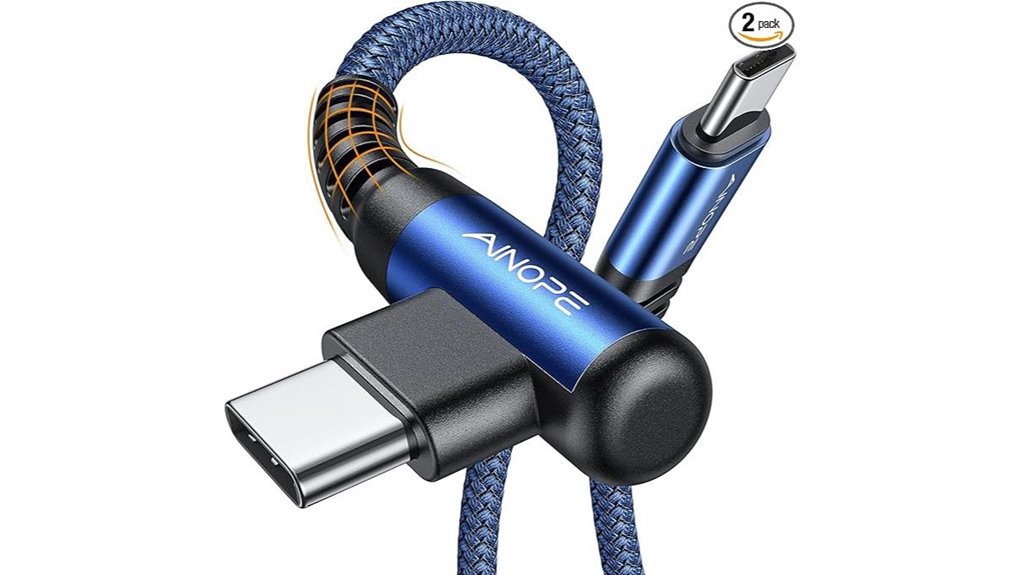
Stay powered on the go with AINOPE’s reinforced‑end USB‑C cables—built for the power‑hungry user who juggles phones, tablets, and laptops every day. You’ll get a 2‑pack of 6.6‑ft, nylon‑braided cables in a sleek blue that fit iPhone 16 Pro Max, Galaxy S24, iPad Pro, and other USB‑C gear. The innovative 90° right‑angle connector and laser‑welded SR joint block breakage, while the braid stops tangles. With USB‑C PD 3.0/QC 3.0, it delivers up to 60 W—80 % charge in 30 min—and 480 Mbps data transfer. After 40 000 bends, the cable stays strong, and the 18‑month warranty backs it.
Best For: anyone who needs a rugged, fast‑charging USB‑C cable for multiple devices—phones, tablets, and laptops—while on the go.
Pros:
- 60 W power delivery for rapid charging (80 % in 30 min).
- 90° right‑angle connector and laser‑welded SR joint for enhanced durability and tangle‑free use.
- Nylon‑braided build and 40,000‑bend test guarantee long‑lasting strength.
Cons:
- Slightly thicker profile may not fit tight spaces.
- Only 6.6‑ft length could be limiting for some setups.
- 18‑month warranty feels short compared to some competitors.
https://www.amazon.com/dp/B09KTCC17K
25 ft Nylon Braided USB‑C Charge‑Only Cable
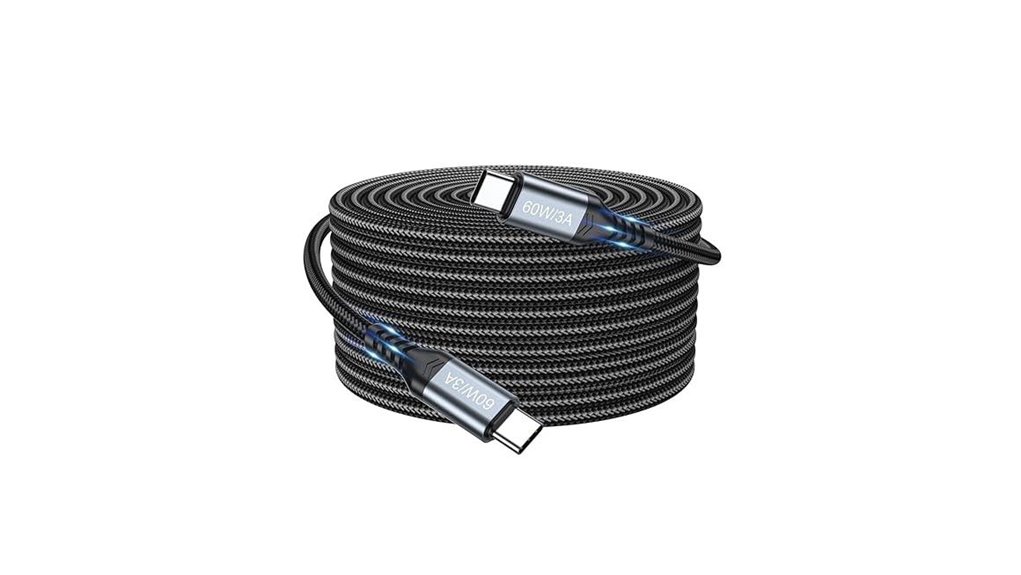
Want a cable that keeps your device powered even when the outlet is out of reach? The 25‑ft OrmQ nylon‑braided USB‑C charge‑only cable lets you power phones, tablets, gaming consoles, or cameras from across the room. Its thick, high‑AWG copper cores deliver 60 W/100 W USB‑PD with minimal voltage drop, so your iPhone or iPad Pro stays juiced up even 6 m away. Double‑braided nylon resists tangles, pets, and floor traffic, while reinforced connector necks endure repeated bending. Ideal for permanent setups like security cameras or remote laptop charging, this cable stays tough indoors or outdoors. Stay connected wherever you roam, always.
Best For: people who need long‑distance, reliable charging for phones, tablets, gaming consoles or security cameras without data transfer.
Pros:
- 25‑ft length with high‑AWG copper cores delivers 60 W/100 W USB‑PD with minimal voltage drop.
- Durable double‑braided nylon and reinforced connector necks resist tangles, pets, and floor traffic.
- Charge‑only design eliminates data and video interfaces, simplifying usage and reducing cost.
Cons:
- Lacks data transfer, so not suitable for USB‑C devices that require file sync or video output.
- The 25‑ft length can be cumbersome to manage in tight or cluttered spaces.
- Slightly heavier (≈230 g) than standard short cables, which may affect portability.
https://www.amazon.com/dp/B0G1YJLD2P
DEWALT 6ft USB‑C Fast Charging Cable
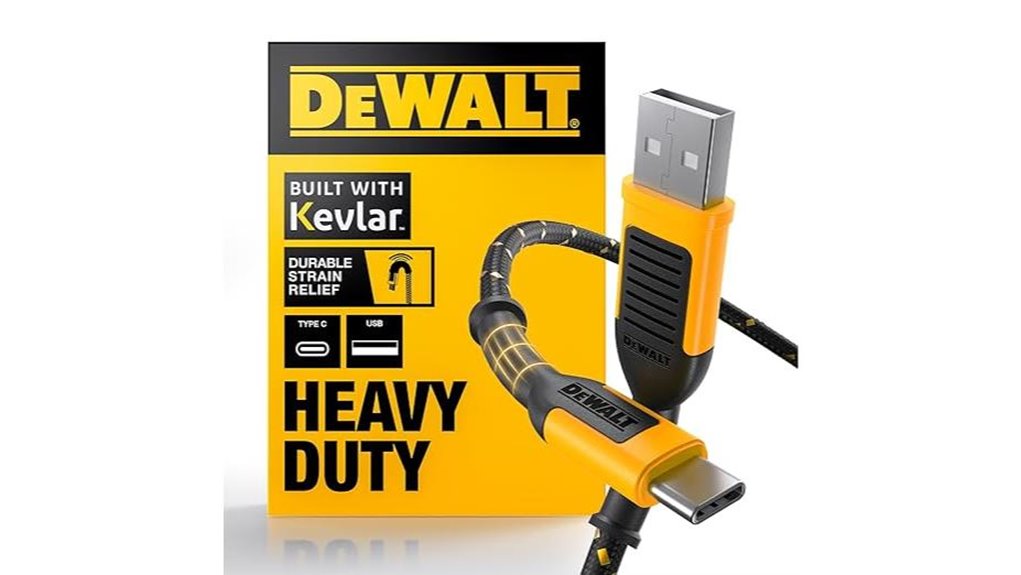
Designed for field technicians and on‑the‑go professionals, this 6‑ft DEWALT USB‑C Fast Charging Cable shields your gear with a Kevlar‑reinforced braided core and strain‑relief design that lets everyday bending go ahead without whipping the wire. It’s lightweight—just 2 oz—yet runs a 6‑ft length that lets you jump between workstations. This male‑to‑male USB‑A to USB‑C fits laptops, tablets, and phones, while its 480 Mbps data rate keeps transfers snappy. The rugged nylon sheath resists cuts, abrasions, and harsh chemicals. DEWALT’s indoor/outdoor rating means it works under sunny desks or rainy fields. Grab this cable for lasting durability and power on the move.
Best For: field technicians, mobile professionals, and anyone needing a durable, fast‑charging USB‑C cable for on‑the‑go power and data transfer.
Pros:
- Kevlar‑reinforced braided core for exceptional durability and long‑term wear resistance.
- 6 ft length offers flexibility to connect devices across workstations without cable clutter.
- Light weight (2 oz) and strain‑relief design prevent breakage from frequent bending.
Cons:
- USB‑2.0 data rate (480 Mbps) may be slower for high‑volume file transfers compared to USB‑3.0/3.1.
- Male‑to‑male design limits use with devices lacking a USB‑A port (e.g., newer laptops).
- No color or accessory options; only a single black unit is available.
https://www.amazon.com/dp/B0821R98PX
SweGuard 2-Pack Right Angle USB-C Fast Cable
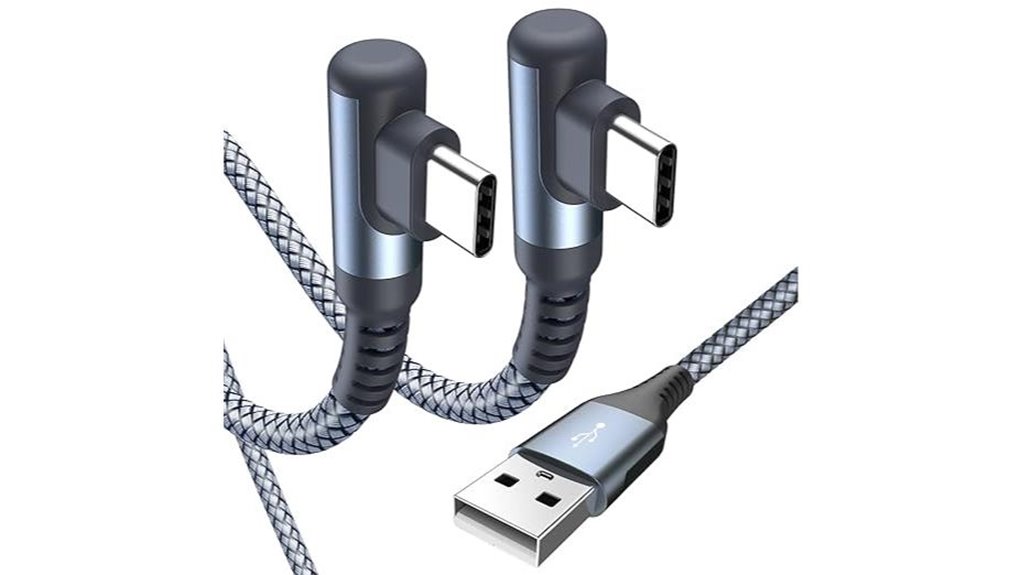
If you’re a frequent traveler or a daily commuter, the SweGuard 2‑Pack Right‑Angle USB‑C Fast Cable’s 3.1 A charging capability and its anti‑break design—over 40,000 bend repetitions—mean you’ll never have to replace a cable after a quick desk shuffle or a long road trip. The 6.6‑ft length lets you use it at a desk or in a car. A dual‑braided nylon jacket keeps heat in check, and the right‑angle USB‑C connector stops awkward bends. It works with iPhone, Samsung, Pixel, and other USB‑C devices, delivering 480 Mbps data transfer. The 18‑month warranty and 24/7 support keep power reliable everywhere anywhere anytime.
Best For: frequent travelers and daily commuters who need a durable, fast‑charging cable that stays kink‑free on the go.
Pros:
- 3.1 A fast‑charge and 480 Mbps data transfer for quick power and file transfers.
- 40,000+ bend repetitions “anti‑break” design keeps cables intact during heavy use.
- Dual‑braided nylon jacket and laser‑welded metal connectors enhance longevity and heat dissipation.
Cons:
- 6.6 ft length may be too long for tight desk setups.
- No mention of compatibility with older USB‑A devices or adapters.
- 18‑month warranty is generous but some users may prefer longer coverage.
https://www.amazon.com/dp/B09GB4W4LP
DEWALT Heavy Duty 2in1 USB-C Fast Charger
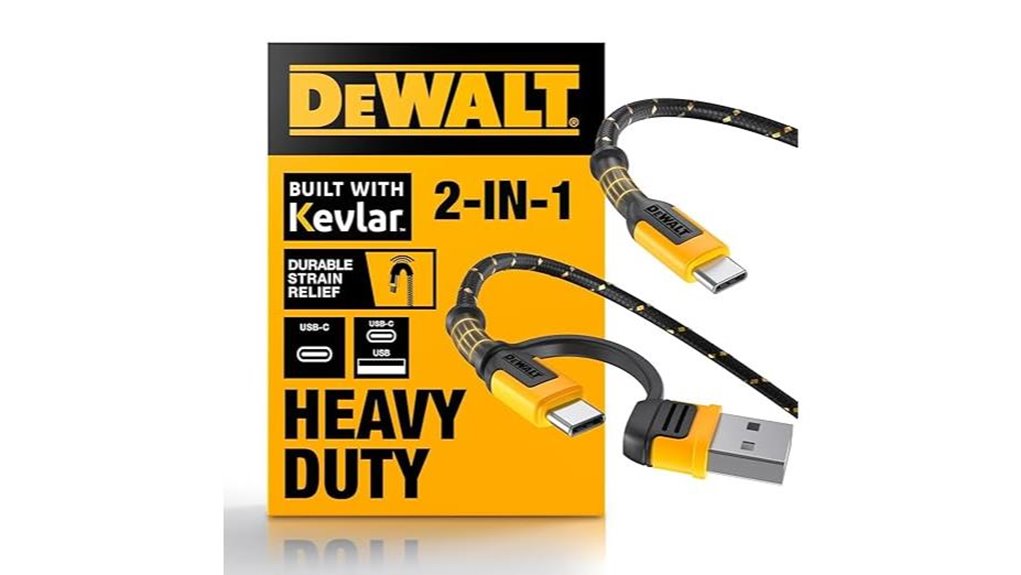
Looking for a rugged cable that keeps up with your mobile work? The DEWALT Heavy‑Duty 2in1 USB‑C Fast Charger delivers 60‑W PD power and data sync over a 6‑ft Kevlar‑braided cable. Its dual‑strain‑relief ends and outdoor‑rated build survive daily bending and twisting. The 28‑pin design supports 15 A power and 13 A data, powering iPhone 16/15 Pro Max, iPad, MacBook, Samsung Galaxy, and more. A USB‑A to USB‑C adapter lets you use older chargers. Weighing just 2.08 oz, it comes in black or yellow with a handy cable wrap. Its robust connector gender—male‑to‑male—ensures easy plug‑in for every device and keeps your workflow moving.
Best For: professionals, DIYers, and outdoor workers who need a rugged, high‑power USB‑C cable that can handle daily bending, twisting, and a variety of devices.
Pros:
- 60‑W PD fast charging with 15 A power delivery and 13 A data throughput.
- Kevlar‑braided cable with dual strain‑relief ends and outdoor‑rated construction for durability.
- Includes a USB‑A to USB‑C adapter and cable wrap for versatility and easy organization.
Cons:
- 6‑ft length may be too long for tight workspaces or too short for some setups.
- Only two color options (black / yellow) limit aesthetic flexibility.
- Lacks built‑in cable locking or temperature protection for extreme environments.
https://www.amazon.com/dp/B0DG3WBPKR
USB-C Fast Charging Cable (Metal Braided, 6ft, 2-Pack)
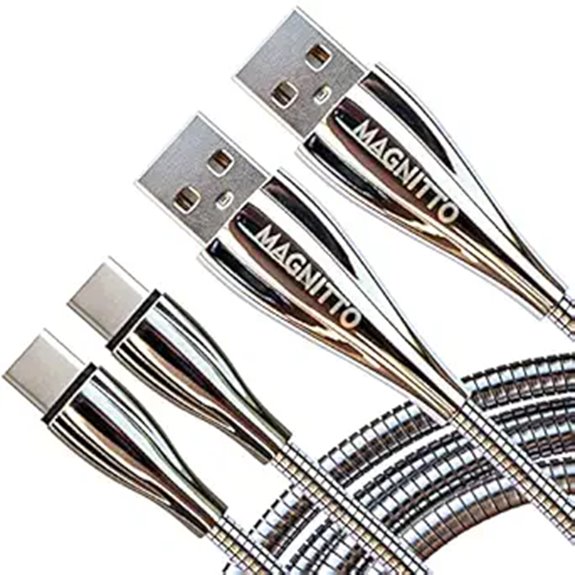
For pet owners and gamers alike, this rugged cable delivers a reliable, 3 A fast‑charge experience in a sturdy, 6‑foot, two‑pack bundle that resists chewing, bending, and daily wear. You’ll appreciate the metal‑braided sheath, which can bend 20 000 times and survive 20 000 plug cycles without fraying. With USB‑A to USB‑C connectors rated for 20 V, 15 W and a 480 Mbps data rate, you’ll charge phones, headsets, or even a PS5 controller swiftly. Stainless‑steel heads and zinc‑alloy plugs add extra durability, while the UL 9990 rating guarantees safe indoor or outdoor use. This cable fits Samsung, Sony, Google, and Xbox devices alike everywhere today.
Best For: pet owners and gamers who need a rugged, fast‑charging cable that can handle chewing, frequent bending, and multiple device types.
Pros:
- 3 A current delivery for quick charging up to 15 W on USB‑A → USB‑C.
- Metal‑braided sheath with 20 000 bend and plug‑cycle lifespan for long‑term durability.
- UL 9990 indoor/outdoor rating ensures safe use in varied environments.
Cons:
- Limited to 3 A (15 W), so it won’t support newer 10 A or higher‑wattage fast‑charging standards.
- The reinforced construction makes the cable bulkier and less flexible than standard flat cables.
- Price point is higher than typical single‑pack USB‑C cables, which may deter budget shoppers.
https://www.amazon.com/dp/B0868GX11C
Factors to Consider When Choosing Charging Cables With Reinforced Ends (Long Life)
You should first check the connector durability—reinforced metal tips keep the USB‑C from fraying after repeated use. Next, evaluate material quality, looking for nitride‑coated copper, heat‑resistant silicone, and a flexible braided sheath that won’t kink. Finally, choose a length that suits your workflow and back it with a brand that offers a solid warranty for peace of mind.
Connector Durability
Resilience matters most when it comes to charging cables, and choosing a reinforced design keeps your device powered reliably. You’ll notice laser‑welded metal housings resist cracking under repeated bends, extending life beyond typical 6,000–40,000 cycles. Strain‑relief loops or silicone gaskets divert flex from the junction, preventing micro‑fractures in internal contacts. A double‑braided jacket shields against abrasion, keeping connectors from loosening. Heat‑sealed anodized pins stay clean, resist oxidation, and maintain signal integrity after thousands of power cycles. Confirm connector gender and pitch match exactly; mismatched pins wear faster and may snap crimped joints. Focusing on these durability cues will extend lifespan and keep charging effortless. By choosing cables that incorporate these reinforced features, you safeguard your devices from unexpected downtime while enjoying reliable connectivity. everywhere.
Material Quality
Because the materials inside cable dictate how long it will keep delivering power, you’ll want to start with high‑purity copper cores that keep voltage drops under 0.1 V even over 25 ft. Pair those with aluminum or titanium housings rated at 200–300 psi, which survive more than 30 000 bends at a 3‑mm radius, keeping connectors straight. Wrap the conductors in a dual‑braided nylon jacket embedded with Kevlar or stainless‑steel strands; this raises endurance to 60 000 bends while maintaining core stiffness above 0.6 psi, preventing fraying. Finish with die‑cast or laser‑welded metal connectors that include a spring‑loaded contact layer, sustaining 4 A/5 V delivery through cycles. Use PTFE or UHMWPE dielectrics to separate metal reinforcement from the sheath—these materials offer ~4.4 W cm⁻¹ K⁻¹ heat transfer and keep temperatures under 30 °C during fast charging.
Cable Flexibility
When you pick a charging cable, its bending radius is your first test—cables engineered for a 2–3 mm radius keep conductors from cracking even after 10 000+ bends. Choose one with a wet‑xylite or nylon‑braided sheath; that material stays elastic after thousands of flexes, so kinks won’t block power. Staggered‑core designs lower stiffness, letting the cable compress and spring back without losing connection integrity over time. Reinforced ends with stress‑relief loops spread bending forces evenly, stopping localized strain that would otherwise wear the most flexed sections. Cables rated for 20 000+ cycles use a mid‑core copper strand of at least 20 AWG, balancing flexibility and strong current capacity. These qualities let you loop the cable around a desk or bag without fear of sudden failures, keeping device charged.
Length Versatility
If you’re looking for a cable that can fold around furniture, the length you pick matters as much as its reinforced ends. Think first about where you’ll keep your devices. A 6‑ to 8‑foot cable covers most office desks or bedside setups, keeping cords neat in tight spots. If you’re a home entertainer, a 10‑foot cable lets you charge from behind a couch without tangling. When you share a living room or open office, a 20‑foot cord frees you to place devices anywhere—its double‑braid sheath stops kinks even with frequent bending. In garages, boats, or remote spots, 25‑or30‑foot lengths keep the power reach long while the reinforced ends resist constant flexing. Match length to routine space use, and you’ll avoid buying more than you need.
Brand Warranty
A three‑year warranty on reinforced cable ends often covers manufacturing defects and mechanical failures caused by constant bending or stress, giving you peace of mind in high‑traffic spaces. But remember, many vendors require you to ship the faulty cable back, which can add surprise costs before the warranty expires. You’ll also need to read the fine print: drops, extreme temperatures, or misuse usually fall outside coverage. Some brands replace the whole cable; others only swap the connector if the wiring stays intact. If you find the terms too tight, you might pay a few dollars for a six‑month or yearly extension; sometimes that offers better value than a fully refurbished cable. You’ll also avoid unexpected repairs, keeping your workspace productive and peace of mind.
Heat Resistance
Since reinforced connectors frequently use ceramic or metal housings, you can trust them to withstand peak temperatures of up to 105 °C without warping or degrading the copper cores.
You’ll notice that many cables embed a thermal cut‑off that shuts power when temperatures rise past 60 °C, protecting the wires and extending life.
Aluminum alloy cores keep heat from building up, ensuring steady voltage even during fast‑charging bursts.
High‑grade silicone sleeves resist heat shrinkage, so the cable stays taut and insulated, preventing breakdown after repeated bends.
Some cables layer infrared or temperature sensors that adjust current on the fly, keeping junction temps below safe limits for longevity.
Compatibility Scope
Because the connector type determines compatibility, you should first verify that the cable’s plug—USB‑C, Micro‑USB, or Lightning—matches the port on your device. Make sure the cable’s rating supports at least 5 V × 3 A or 20 V × 3.1 A if you want 60 W PD. If you need data sync or display, choose a cable that supports full data lines; charge‑only types will work only for power. Dual‑connector reinforced cables can power a phone and peripheral simultaneously, but they must detect host versus device roles correctly to avoid voltage conflicts. Right‑angle ends suit tight spaces, yet they require chargers that tolerate a 90°‑to‑horizontal conversion and reverse‑polarity compatibility. By matching connector type, power rating, data capability, dual‑role logic, and right‑angle compatibility, you guarantee your reinforced cable serves every charging need reliably and lasts for years of use.
Bend Life Test
When you compare reinforced‑end cables, start by looking at their bend‑life rating—most manufacturers list checkpoints at 2 000, 5 000, 10 000, or 20 000 full flexes. A 20,000‑plus rating usually means the cable features reinforced braid and thicker jacks, giving it extra strength against daily twists. The test alternates the cable between flat and 90° angles, stressing both ends and the midsection equally so no single spot fails early. Higher bend‑life scores cut kinks, which otherwise cause voltage dips and disrupt charging. Brands publish these results on packaging, letting you gauge how long a reinforced‑end cable will actually perform before it cracks. Easier still, choose a cable rated for 10 000–20 000 bends; higher ratings mean it resists kinks and snaps during day‑to‑day twists and tight storage and endure.
Häufig gestellte Fragen
How Does the Reinforced End Differ From a Metal Braided Design?
A reinforced end wraps the cable tip in layers of durable polymer or woven fiber, sealing the metal contacts inside. By contrast, a metal‑braided design exposes the metal and wraps it with a steel or stainless‑steel braid. The reinforcement keeps the contacts protected and prevents unscrewing, while the braid adds a shield that’s less rigid but can still tug on the cable. Which type you choose depends on your usage.
Are Reinforced Cables Compatible With All Usb‑C Devices?
Yes, reinforced USB‑C cables work with virtually every USB‑c device you own. As long as the cable’s plug follows the USB‑c specification, you’ll power, charge, and transfer data just right. Some niche headphones or docks might still need their original cable, but for the typical laptop, phone, or tablet, the reinforced design will plug in and perform flawlessly. Keep an eye on the pin layout. Simply make sure they’re rated.
Can I Repair an End That Has Frayed?
Coincidentally, you’re probably wondering if you can fix a frayed cable end right now. You can patch it up, but the repair isn’t foolproof. Trim the frayed strands, then slide a heat‑shrink tube over the exposed wires. Heat it with a lighter or hairdryer, snugging the tube tight. Finish with a drop of clear epoxy to seal the cable. Still, the repair may fail under heavy strain, so monitor usage.
What Is the Best Method to Protect Cables During Travel?
Use a protective sleeve or a dedicated travel pouch to keep the cable safe. Keep the cable wrapped loosely around a soft core, then slide it through a zip‑lock case. Place the wrapped cable in a rolled pouch, so it won’t get twisted against other gear. Finally, label the pouch to avoid confusion during packing or unpacking and stay safe. Feel confident knowing the cable is protected wherever you go.
Does the Reinforced End Affect Charging Speed or Signal Quality?
Coincidence is when unrelated events align—like a reinforced cable meeting your device’s power and data pathways yet staying compliant with industry standards. You’ll find that the added durability doesn’t throttle charging rates, nor does it muddle signal integrity. In fact, manufacturers embed identical conductors, so voltage drops remain within acceptable limits and data transfer stays stable. So, rest easy: strength doesn’t cost speed. Even on high‑power USB‑C charges, you’re clear.
Schlussfolgerung
By now you’ve seen how reinforced‑end cables blend ruggedness with convenience, letting you stay plugged in without a care. Think of them as your trusty travel companions, quietly enduring everyday wear. They promise fewer frays, more longevity, and peace of mind, so you can focus on what matters. Choose wisely, enjoy seamless connectivity, and let your charging routine evolve into a hassle‑free, enduring experience that feels almost timeless. Right from the first plug‑in daily everywhere
Durable charging cables, Long lasting cords, Reinforced cable ends
 German
  English
  French
  Italian
  Spanish