
Best Power Banks for Travel That Stay Under 200g

Introducing Maria, our meticulous planner and talented visual storyteller. She has a knack for discovering those hidden gems, chic boutique spots, and charming little cafes that add a touch of elegance to every journey. With her keen eye for photography and her passion for travel, Maria will transport you to the most enchanting corners of the world, inspiring you to explore new places, one picture-perfect destination at a time.
Want a charger that fits in your backpack? The Miady 2‑pack 5,000 mAh feeds you with dual USB‑C inputs and built‑in Lightning cables, weighing only 4.2 oz each. GUSGU’s 5,000 mAh unit adds a fold‑out AC plug and 20 W PD, all under six ounces. Pixy Mini offers a 20 W PD output, dual ports, and a credit‑card size footprint, with a 98‑gram weight. Each packs 18.5 Wh, airline‑approved and safe with UL passes. Ready to see which one suits your trips?
Wichtigste Erkenntnisse
- Prioritize 5,000‑mAh power banks, which are airline‑approved (≤18.5 Wh) and weigh ~200 g or less.
- Look for models offering built‑in cables or fold‑out AC plugs to eliminate extra cords, e.g., Miady, GUSGU, Pixy Mini.
- Ensure the bank supports 20 W PD output for fast phone charging and laptops, and 18 W input for ~1.5 h recharge.
- Verify UL or equivalent safety certifications, temperature‑sensing, and over‑charge protection for safe travel use.
- Consider dual or multiple ports for simultaneous device charging, reducing the need for a separate charger.
Miady 2-Pack 5,000 mAh Portable Power Bank
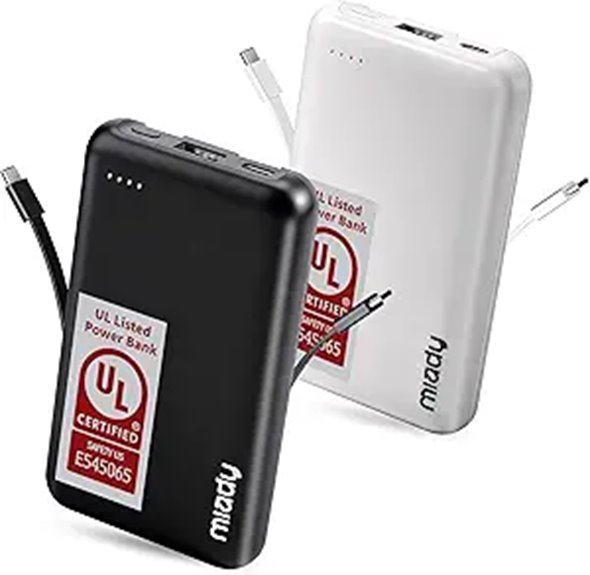
The Miady 2‑Pack 5,000 mAh Portable Power Bank is the perfect travel companion for anyone who values safety and convenience on the go.
You’ll appreciate its UL‑listed safety, 3.6 × 2.4 × 0.5‑inch body, and 4.2‑ounce weight—perfect for any pocket. The 5,000‑mAh (18.5 Wh) capacity is airline‑approved. Each unit includes two built‑in Lightning and USB‑C cables, eliminating external cords. Dual USB‑C inputs let you recharge faster or use the bank as a source. With three outputs—USB‑C, USB‑A, and Lightning—you can power up to three devices at once. LED status, short‑circuit protection, and a sleek black‑white design keep it reliable and keeps you connected wherever you go.
Best For: travelers, commuters, and anyone needing a compact, multi‑device power solution on the go.
Pros:
- Built‑in Lightning and USB‑C cables eliminate the need for external cords.
- UL‑listed safety certification with over‑heat, short‑circuit, and battery stability protection.
- Three simultaneous outputs (USB‑C, USB‑A, Lightning) enable charging up to three devices at once.
Cons:
- Only 5,000 mAh per unit, which may be insufficient for high‑demand laptops or extended trips.
- No dedicated fast‑charge input for the power bank itself; recharging may be slower.
- The 2‑pack bundle adds extra weight and bulk for some users’ travel needs.
https://www.amazon.com/dp/B0G34F2PKL
GUSGU 5000mAh Power Bank
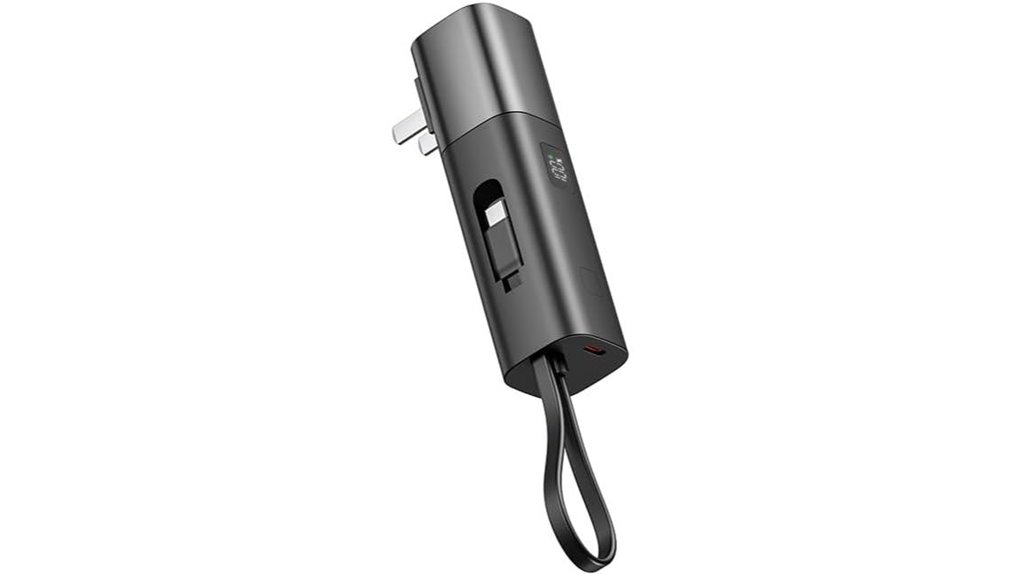
Whether you’re on a long haul or a quick trip, the GUSGU 5000 mAh power bank keeps you charged in style because its 3‑in‑1 design packs a USB‑C port, a built‑in cable, and a fold‑out AC plug into a single, airline‑approved, 6.4‑ounce unit—so you’ll never need to juggle extra cords or unpack a portable charger.
It delivers up to 20 W PD, charging 5 kWh quickly. Wall mode tops 15 W for laptops, tablets, and phones. Smart, temperature‑sensing tech stops overcharge, and 5000 mAh Li‑polymer core provides a safe single charge per trip. Essentials stay powered without bulk, keeping carry‑on ultra sleek and compliant.
Best For: Travelers who need a compact, airline‑approved charger that combines USB‑C, a built‑in cable, and a fold‑out AC plug into one lightweight unit.
Pros:
- 3‑in‑1 design eliminates the need for multiple cords and reduces travel clutter.
- Fast PD up to 20 W on the go and 15 W wall mode for laptops, tablets, and phones.
- Smart, temperature‑sensing technology stops overcharging for safe, efficient power delivery.
Cons:
- 5000 mAh capacity limits the number of full charge cycles per trip.
- 20 W output is modest for high‑power laptops, leading to slower charging times.
- The fold‑out AC plug can be a bit cumbersome to set up and may be fragile over time.
https://www.amazon.com/dp/B0DFZ1QGR3
Pixy Mini 5000mAh 20W PD Power Bank
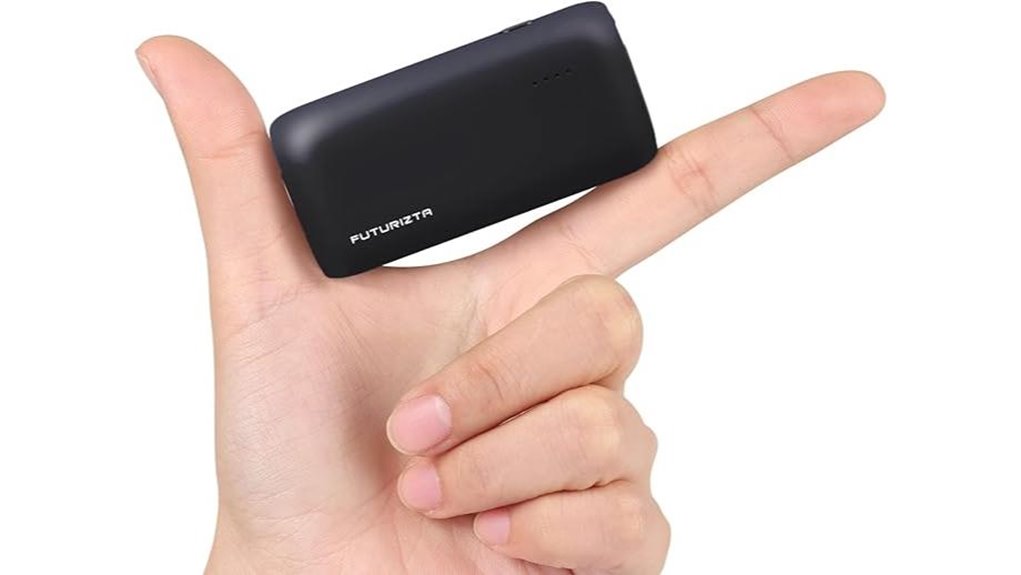
For travelers who need a compact, ultra‑light charge on the road, the Pixy Mini delivers just that—98 g of pure power that fits in a pocket or wallet. At 98 g and only 2.8″×1.2″×0.8″, it slips into any credit‑card slot. The 20 W PD output charges an iPhone to 60 % in half an hour and gives a second full charge, while still powering iPad Pro, Switch, or MacBook Air. Dual USB‑A and USB‑C ports let you charge two devices simultaneously; low‑current mode suits watches and earbuds. Its 5000 mAh 21700 cell fills in 1.5 h via 18 W input, three times faster than average banks in practice.
Best For: travelers, commuters, and anyone looking for a pocket‑sized, ultra‑light power solution that offers rapid charging for devices like iPhones, iPads, and even laptops.
Pros:
- Ultra‑compact, credit‑card size (98 g) fits any pocket or wallet.
- Dual ports with 20 W PD output supercharges smartphones, tablets, and laptops.
- Fast 1.5‑hour recharge via 18 W input, 3× quicker than typical banks.
Cons:
- 5000 mAh capacity may only provide one full charge for high‑end laptops.
- No built‑in USB‑C to USB‑A cable for older devices (only provided cable).
- Relies on 18 W charger to reach full recharge speed; slower with lower‑power inputs.
https://www.amazon.com/dp/B09Q9C2FRC
Factors to Consider When Choosing Power Banks for Travel Under 200g
When you pick a pocket‑sized power bank, weight and portability steer your first choice. Make sure you choose a model that balances capacity for your typical usage times, offers fast charging, and is fully compatible with your devices. Also, check for recognized safety certifications and durable construction so you’re confident it will survive travel bumps.
Weight and Portability
Why should you obsess over a power bank that stays under 200 g? Because its compact size—roughly 3–4 inches long, 2–3 wide, and a flat 0.4–0.5 tall—fits snugly in a wallet or pocket, keeping your baggage light. Most 4 000–5 000 mAh models hit a weight‑to‑capacity ratio of about 0.04–0.05 g per mAh, giving you strong juice without bulk. With an 18 W PD input, these units recharge fully in 1.5–2 hours, meaning you won’t wait long for a power boost. Their volume stays below 60 cubic inches, satisfying airline carry‑on rules for both weight and space. Ultra‑flat designs reduce rolling resistance in suitcases and keep the phone stable during quick transfers. Additionally, a lighter power bank lets you carry devices without exceeding limits, while profile stops obstructions in small daily pockets.
Capacity and Usage Time
Since 80 % of a power bank’s stored energy actually reaches your device, a 4,000‑5,000 mAh pack delivers roughly 4,000 mAh of usable juice—enough to recharge a typical smartphone one and a half to two times and keep it alive for 8–10 hours of standby. Doubling that capacity to 10,000 mAh adds about 37 Wh, giving three to four full smartphone charges or sixteen to twenty hours of continuous standby, still staying under 200 g. For high‑power gadgets, the same 10,000‑mAh pack supplies two to three half‑hour bursts, matching a device’s moderate‑load usage. When you pick a 5,000‑mAh ultralight model, you shed 20 to 30 g compared to bulkier alternatives, preserving portability with modest usage time. If you rarely charge, 4,000‑mAh suffices; frequent commuters crave the extra batch, and fewer pauses for travel today.
Charging Speed and Compatibility
If you need to stay powered on the move, speed and compatibility are more critical than ever. A 5,000 mAh, under‑200‑g bank with 20 W PD can lift a recent iPhone from 0 % to 60 % in about 30 minutes, while a 15 W port still satisfies most Android phones that draw 5–7 W. Dual ports—USB‑C 20 W plus USB‑A 5 W—let you charge a laptop (≈45 W) and a phone at the same time, without throttling. An 18 W PD input model recharges fully in roughly 1.5 hours; a 10 W version takes about 2.5 hours. Built‑in temperature monitoring on 21700 cells keeps each port at a safe 2.5 A (≈12.5 W). All units support Apple 20 W PD, Android PD 3.0, and Qualcomm QC 4.0, covering at least 90 % of modern smartphones worldwide. Keep an eye on the port labels, especially.
Safety Features and Certifications
As you’ve seen, a power‑bank’s speed and compatibility largely influence convenience, but safety is the other side of the coin. First, check that the unit holds an UL or equivalent safety certification; that guarantees compliance with over‑heat, short‑circuit, and battery stability standards. Built‑in surge‑protection and temperature‑sensing circuits automatically shut off charging when heat rises, preventing dangerous build‑ups. A smart‑chip “fill‑and‑stop” feature stops input once the internal battery reaches full, extending life and minimizing fire risk. Dual‑input designs that recharge via cable or port must limit input current; they protect both the bank and your devices from spikes. Finally, airlines only approve power banks that meet strict weight (≈18.5 Wh) and voltage limits, meaning they’ve chosen safety‑grade parts. You’ll travel confidently, knowing your charger stays safe.
Build Quality and Durability
When you’re hunting for a power bank under 200 g, the first thing to check is its build quality. A rigid ABS or polycarbonate shell with reinforced corners can survive 1.5 m drop tests, keeping the unit intact on rough trips. Look for UL‑listed safety certification; it guarantees built‑in thermal sensors and short‑circuit protection, so the lithium‑polymer cells stay healthy even after frequent charges. Thin 21700 cells let the design stay lightweight while offering about 500 full‑charge cycles at 80 % depth. Multiple LED indicators and a secure latch protect connector pins and let you read status at a glance. Airtight USB seals, wrapped in a rubber shock sleeve, keep moisture out and cushion everyday bumps. These rugged details mean never replacing a power bank mid‑trip daily.
Cable Convenience and Accessories
You’ll want to pay attention to the cord side of the equation. Include built‑in Lightning and USB‑C cables—preferably two of each—to keep your bag light. Dual USB‑C input ports mean you can recharge the power bank faster by using either the internal cable or an external charger, so you’re never stuck with a single plug type. A fold‑able AC plug lets the unit double as a wall charger at hotels. Add a USB‑A to USB‑C cable or a universal micro‑USB/USB‑C combo so older or mixed‑connector devices still charge directly. Cables about 1‑2 meters long balance reach and bulk, letting you charge devices a few feet away without tangles or dragging through your luggage. Remember to tuck each cable into its own small pouch or elastic band; this keeps them organized and prevents fraying during travel anywhere, anywhere.
Häufig gestellte Fragen
Can I Use These Power Banks With Electric Cars for Charging My Devices?
Yes, you can use most travel power banks with electric cars. Plug the bank’s USB cable into the car’s 12‑V socket or a USB‑C/USB‑A adapter, and it will charge your phone or tablet while you drive. Keep in mind the car’s output is limited—most 12‑V sockets supply 5 W to 12 W—so heavy‑duty devices may charge slowly. For devices, you’ll use a car charger or an adapter that provides 12 W today.
What Safety Certifications Should I Look for in Under‑200g Power Banks?
First, you should check the ultimate safety boon: verify the power bank flaunts UL 2054, CE, and FCC certifications—these are your safety guardians. Look for a CE mark showing compliance with European safety rules, UL 2054 confirming resilience against overcharge, and FCC for electromagnetic interference. Don’t overlook a built‑in short‑circuit protector and temperature control. A locked‑in package keeps your devices running safely across any adventure for complete peace of mind.
How Long Does a Typical 200G Power Bank Take to Fully Recharge?
Typically, a 200‑gram power bank takes about between eight to twelve hours to fully recharge, depending on its capacity and charger voltage. If you plug it into a 2‑amp charger, expect closer to eleven or twelve. With a 10‑amp output, it may be ready in roughly nine hours. Watch the indicator lights—they’ll confirm when it’s fully charged. And if you use a fast‑charge cable, shave an hour or two today.
Are These Lightweight Power Banks Compatible With Usb‑C PD Devices?
Like a feathered river, these light banks flow effortlessly into your USB‑C PD devices. You’ll find they’re fully compatible, pushing power through the PD handshake just as smoothly as a well‑tuned symphony. Timing may vary—most swing around 5 to 7 minutes for a 20‑minute charge cycle—yet the result? A crisp, rapid recharge that keeps your gadgets humming while you glide through travel in your daily adventures, feeling lighter than air.
Do Power Banks Lose Capacity Faster When Cycled Frequently on Trips?
Yes, they do. Those with lithium‑ion cells lose capacity a bit quicker when you repeatedly drain and recharge them on the go. The frequent charge‑discharge cycles add stress to the cells, especially if you push them to ~0% or over‑charge. Keep chargers at 80%‑90% and use balanced ratcheting to preserve battery life while traveling. Newer models often have cycle wear management, and firmware tweaks can really help you maintain capacity.
Schlussfolgerung
Imagine a tiny backpack weighing less than your credit card, yet humming with enough power to light up a campsite. That’s the 5,000 mAh Pixy Mini: it weighs 190 g, charges your phone 4–5 times, and fits in your pocket. When you’re jet‑lagged, a light, reliable bank feels like a pocket‑sized compass—guiding you home to a full screen without the bulk. Every night, you pull it out and hear the reassuring buzz of a pocket‑sized sunrise daily.
Lightweight power banks, Portable battery safety, travel chargers
 German
  English
  French
  Italian
  Spanish