
Snowshoes for Travel (Flat Packing) That Save Your Backpack

Introducing Maria, our meticulous planner and talented visual storyteller. She has a knack for discovering those hidden gems, chic boutique spots, and charming little cafes that add a touch of elegance to every journey. With her keen eye for photography and her passion for travel, Maria will transport you to the most enchanting corners of the world, inspiring you to explore new places, one picture-perfect destination at a time.
Looking for snowshoes that collapse straight into your backpack? Choose a lightweight, 21‑ to 30‑inch model with a short, sturdy frame—brands like G2 or Odoland fit neatly into a pouch. Pair them with a tote bag, such as the MSR Snowshoe Tote, to keep your gear dry and organized. These options let you pack less, travel farther, and stay comfortable on packed trails. Want more details? You’ll explore the best setups that keep your pack light.
Wichtigste Erkenntnisse
- Choose 18‑22‑inch flat‑fold snowshoes (G2 21‑in, MSR EVO 22‑in, Odoland 21‑in) to compress to ~18‑20 in, fitting most backpacks.
- Pick aluminum‑ or HDPE‑frame models that collapse flat and add minimal weight (2.8–3 kg), preserving pack space.
- Use a dedicated tote or backpack with pole holders (MSR EVO Tote Bag, Atlas Snowshoe Tote) so poles nest and free bag volume.
- Opt for models without tails or bulky crampons, e.g., G2 25‑in or MSR EVO, to keep the shoe’s footprint slim and packable.
- Include lightweight, flat gaiters (e.g., Odoland’s 1‑cm pongee) that add only a few inches of depth, preventing excess bag bulk.
Odoland Aluminum Snowshoes with Poles
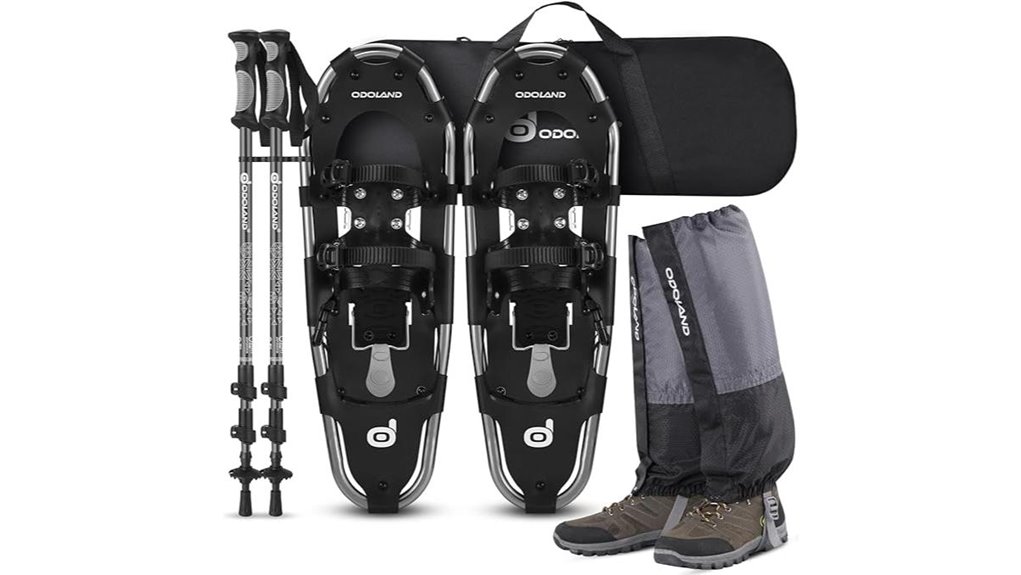
You’re looking for snowshoes that won’t make your travel bag heavy, and the Odoland Aluminum Snowshoes with Poles give you exactly that. Their lightweight aluminum frames weigh just a few kilograms, so you can pack two 21‑inch models for a 80‑120 lb rider and still leave room for gear. The 1‑cm depth and double saw‑tooth tread grant perfect flotation on soft snow while delivering traction on icy patches. Telescoping 25.5‑54‑inch poles balance heat‑resistant steel tips, and adjustable grips fit gloves for comfort. Waterproof pongee gaiters resist tears, and a dedicated carry‑bag stores every part, keeping your backpack tidy for you.
Best For: 80‑120 lb riders who need lightweight, high‑flotation snowshoes that easily fit into a travel bag.
Pros:
- Ultra‑light aluminum frame keeps the overall weight down while maintaining strong structure
- Dual saw‑tooth tread gives excellent traction on icy edges and superior flotation on soft snow
- Telescoping poles with heat‑resistant steel tips and glove‑friendly grips make winter trekking comfortable
Cons:
- Limited to 21‑30 in sizes; larger riders may need the biggest model
- The 1‑cm depth may not provide as much surface area as heavier, cubic‑type snowshoes
- Pongee gaiters are durable but still can tear if exposed to sharp, rocky terrain
https://www.amazon.com/dp/B08CH86BK4
MSR Snowshoe Tote Bag, Fits 25‑inch Snowshoes
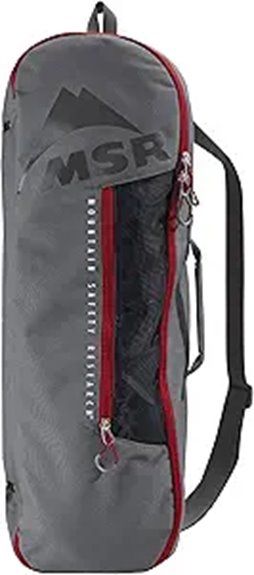
For those heading out in the snow, the MSR Snowshoe Tote Bag packs the convenience and durability required for travelers with 25‑inch snowshoes: its 28‑liter capacity is protected by a PFAS‑free DWR coating that locks out moisture. You can carry the bag on your shoulder with adjustable straps, or grab it by hand for quick trips. The mesh vent panel and drain grommet keep your snowshoes dry during long storage. Hook‑and‑loop tabs attach your poles, while the internal sleeve holds extra tails. Lightweight at 12 oz, it fits in any backpack and lasts with a 3‑year warranty every time today.
Best For: Snowshoeers who carry 25‑inch models and need a lightweight, durable tote for both transport and long‑term storage.
Pros:
- PFAS‑free DWR‑coated fabric keeps gear dry and is eco‑friendly.
- Adjustable shoulder/hand straps and vented mesh panel + drain grommet support versatile carry and moisture control.
- 28 L capacity, 12 oz weight, and 3‑year limited warranty make it lightweight, roomy, and reliable.
Cons:
- Sized only for 25‑inch snowshoes, not suitable for larger models.
- Poles and tail accessories sold separately, adding extra cost.
- Soft‑style construction lacks the hard‑shell protection of some alternative cases.
https://www.amazon.com/dp/B0CS4LQNLY
Athletico Snowshoe Backpack for Carrying and Storing
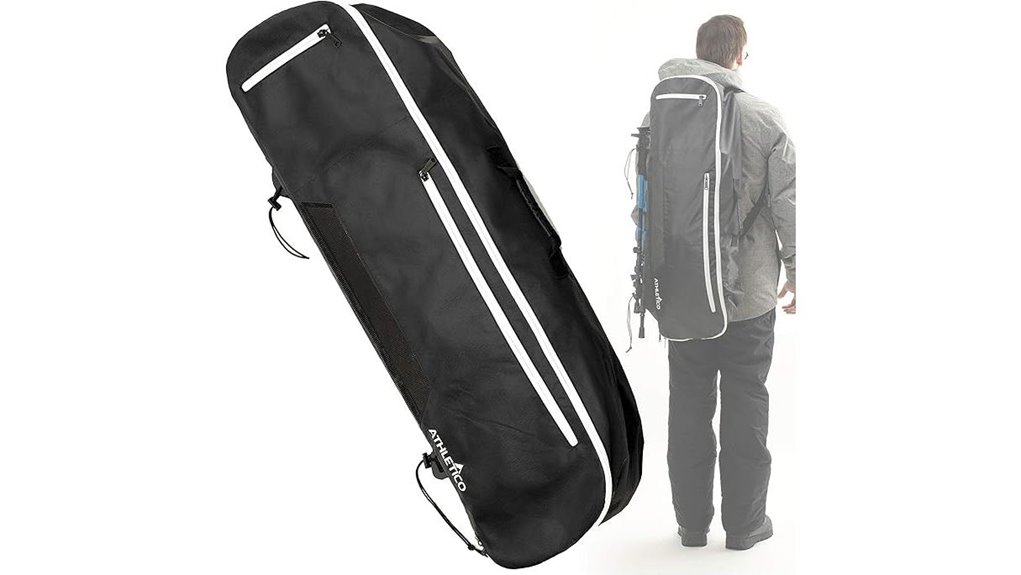
The Athletico Snowshoe Backpack is engineered for backcountry hikers who need to keep their snowshoes and gear within easy reach, all while staying surprisingly light at just 0.69 kg.
You’ll pick SMALL for 19‑25‑inch shoes or LARGE for 25‑36‑inch. It holds trekking poles on exterior bungee‑and‑cord‑lock holders. Adjustable straps and a padded side‑carry handle keep the load accessible. Anchor points let it clip to a larger pack. A big exterior zip pocket stores gaiters, gloves, socks, hats, and snacks; an interior stash pocket holds small items. The soft but rugged shell and easy‑grip zipper pulls simplify packing on the trail quickly.
Best For: Backcountry hikers who need a lightweight, dedicated bag to carry and secure snowshoes and trekking poles while keeping essential gear within reach.
Pros:
- Ultra‑light at just 0.69 kg, adding minimal extra weight.
- Dual‑size options (SMALL for 19‑25″, LARGE for 25‑36″) fit a wide range of snowshoe lengths.
- External pole holders and internal stash pocket enable organized, quick-access storage.
Cons:
- Soft shell offers limited weather protection in extremely harsh conditions.
- Designed mainly for gear that fits the dedicated pockets; not ideal for additional bulky items.
- Intended as a support bag: not sufficient on its own for carrying entire backcountry sets.
https://www.amazon.com/dp/B07VBB1CJL
Odoland Waterproof Snowshoes with Trekking Poles
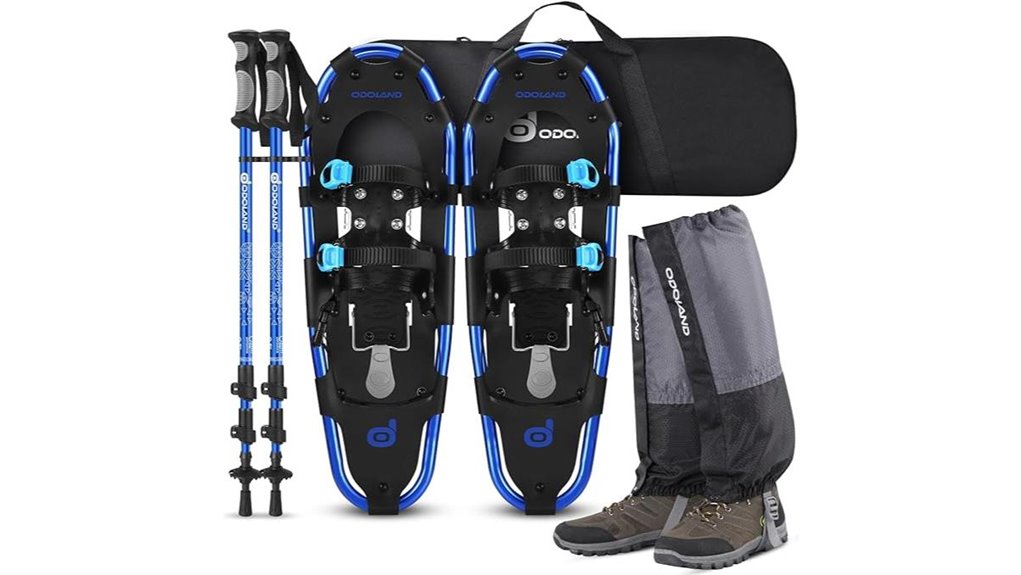
Whether you’re tackling powdery slopes or flat winter trails, Odoland’s lightweight aluminum snowshoes paired with adjustable trekking poles deliver maximum flotation and crisp icy traction—an unbeatable combination for casual weekenders and experienced trekkers alike. You’ll fit a 21‑inch pair in a 0.04‑inch thick frame, weighing 3.06 kg. The 25‑ and 30‑inch models hold 120–160 lb and 160–250 lb, letting you travel with loved ones or gear. Saw‑tooth pads grip ice, while poles spring to 54 in and are adjustable. Waterproof pongee gaiters shield your feet from punctures and tears. Everything ships in compact bag folds flat, making it easy to stash in a backpack.
Best For: adventurous family hikers, solo trekkers, and everyday winter trail users needing lightweight, all‑terrain snowshoeing gear.
Pros:
- Ultra‑light aluminum frame (3.06 kg) for effortless carrying
- Dual reinforced saw‑tooth pads deliver excellent traction on icy surfaces
- Waterproof pongee gaiters protect feet from punctures and keep moisture out
Cons:
- Only available up to 30‑inch size, limiting weight capacity for larger loads
- No adjustable heel‑lift height for differing foot shapes or gait preferences
- Packaged weight of 3.5 kg still sizable for ultra‑compact backpacking setups
https://www.amazon.com/dp/B07V43CXLN
G2 Lightweight 21‑36″ Snowshoes (6 Colors)
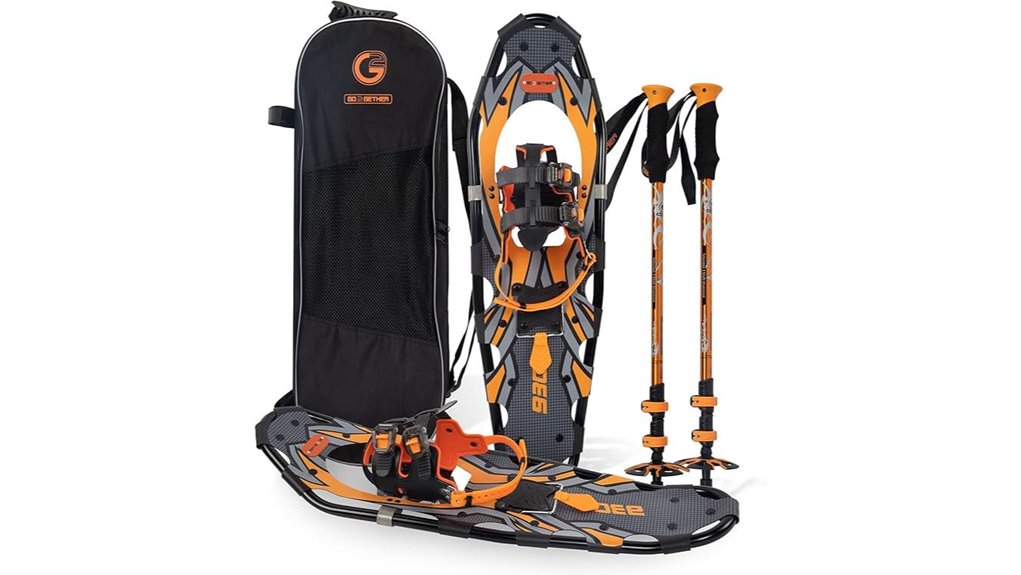
If you’re planning a quick, snow‑covered trek, you’ll appreciate the G2 snowshoes’ ultra‑light 2.88‑kg HDPE deck, which makes hauling them over treacherous terrain—and your suitcase—an effortless task. Your 25‑inch model floats on deep powder, while the 36‑inch version stays steady on packed sidewalks. Fast ratchet bindings let you clip on quickly—even with gloves—tightening your fit in seconds. The high‑quality aluminum crampons bite into ice, giving you confidence on slick slopes. An EVA foam lining warms your feet, while the protective padding shields you from drafts. The included trekking poles and carrying bag make packing seamless for any trip today.
Best For: experienced and casual winter trekkers who need ultra‑light, quick‑setup gear for day trips or short expeditions on snow and ice.
Pros:
- Ultra‑light 2.88 kg HDPE deck keeps total weight low for efficient movement.
- Fast‑ratchet one‑pull bindings and integrated heel lift make setup hassle‑free even with gloves.
- Aluminum crampons provide solid grip on packed snow and icy surfaces, while EVA foam lining warms feet and protects against drafts.
Cons:
- Plastic deck may not endure heavy impact or extreme winter conditions as well as heavier composite materials.
- Weight capacity is capped at 200 lb, limiting use for very large hikers or high‑load scenarios.
- Lack of adjustable toe lock or full‑size strap options may restrict fit for some foot shapes.
https://www.amazon.com/dp/B0B8Y5D1ND
G2 Lightweight Snowshoes 21-30″, Poles, Bag, Gaiters
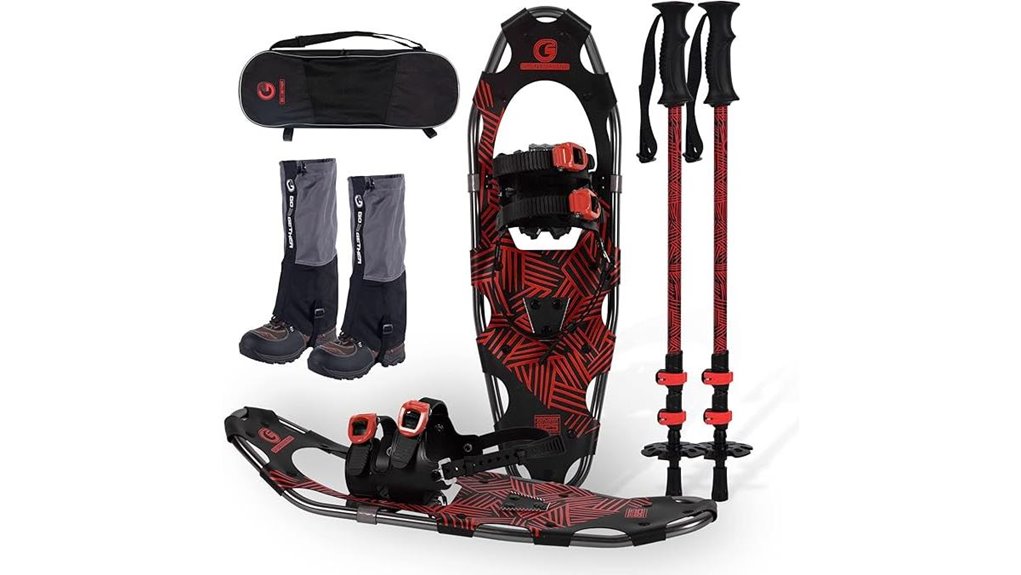
Need a pair that stays light on your shoulder but won’t budge on slick edges?
Choose the G2 set: 21‑30″ snowshoes, trekking poles, tote bag, and gaiters around deck on aluminum frame. The folded shoe is 25.9×11.6×4.4 in, weighs 5.01 kg, and fits into a pouch, keeping your pack lean. One‑finger bindings stay tight in sub‑freezing temperatures, while sharp aluminum crampons give traction on ice. A pivot bar heel lift let you walk on flats and hills. The tote bag clips poles inside, and gaiters shield legs. Bright colors keep them visible. warranty and support cover you from purchase to trail.
Best For: Mountain backpackers who need lightweight, durable snowshoes capable of excellent traction on ice and easy transport.
Pros:
- Lightweight (5.01 kg) with HDPE deck and aluminum frame for quick packing.
- One‑finger fast‑ratchet binding stays secure even in sub‑freezing temperatures.
- Comes with trekking poles, tote bag, gaiters, and bright colors for visibility.
Cons:
- The rigid aluminum frame may struggle in deep, heavy powder.
- Aluminum crampons can wear faster than steel on hard ice surfaces.
- Only three size options (21″, 25″, 30″) may not fit all foot sizes.
https://www.amazon.com/dp/B08ZY96B5B
Yukon Charlie Advanced 8×21 Women’s Snowshoe Kit
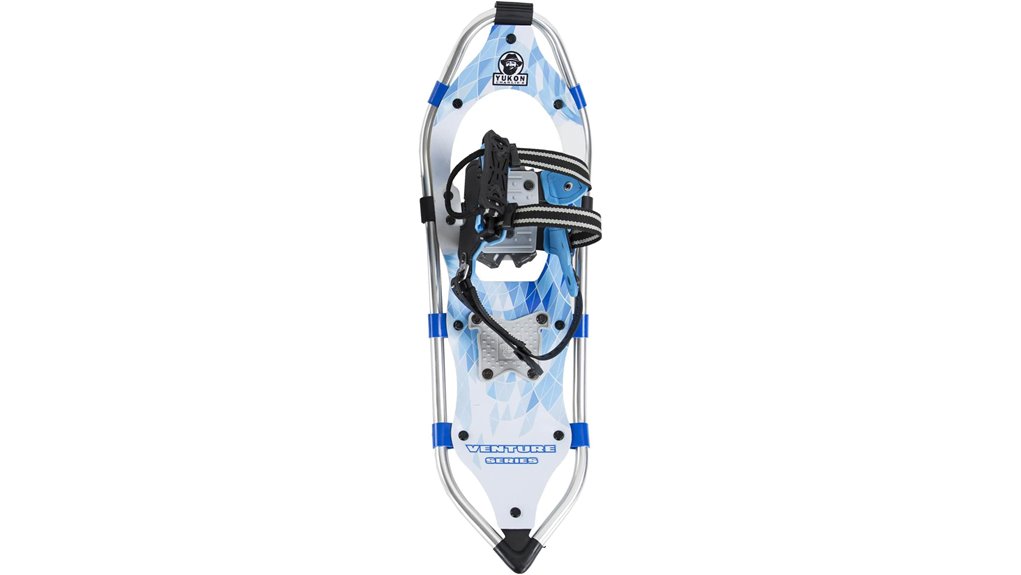
With a travel bag that folds snugly into your pack and a lightweight 6‑lb frame, the Yukon Charlie Advanced 8×21 Women’s Snowshoe Kit is the clear choice for winter hiker who wants to keep moving. The 8×21 inch kit supports up to 150 lb, letting you carry gear without dragging competitors. Forged aluminum frames and high‑strength 6000 Al alloy keep weight low while resisting flex. HDPE decks float and endure cuts, while powder‑coated steel crampons grip ice safely. Rocker V tail and Snow Motion axle improve stride and traction, and Fast Fit II bindings lock footwear securely. Pack it in the bag for off‑season storage.
Best For: adventurous women hikers who need a lightweight, durable 8×21‑inch snowshoe kit with reliable ice traction for mixed snow and ice terrain.
Pros:
- Light 6‑lb frame made from forged aluminum for easy carrying.
- Durable HDPE deck resists cuts and provides good flotation.
- Included trekking poles and travel bag streamline packing and storage.
Cons:
- Limited to a single 8×21 size, not ideal for larger or heavier users.
- Maximum user plus gear weight capped at 150 lb.
- Relies on compatible winter footwear; not a universal fit for all boot types.
https://www.amazon.com/dp/B0778Z22SC
Tubbs Glacier
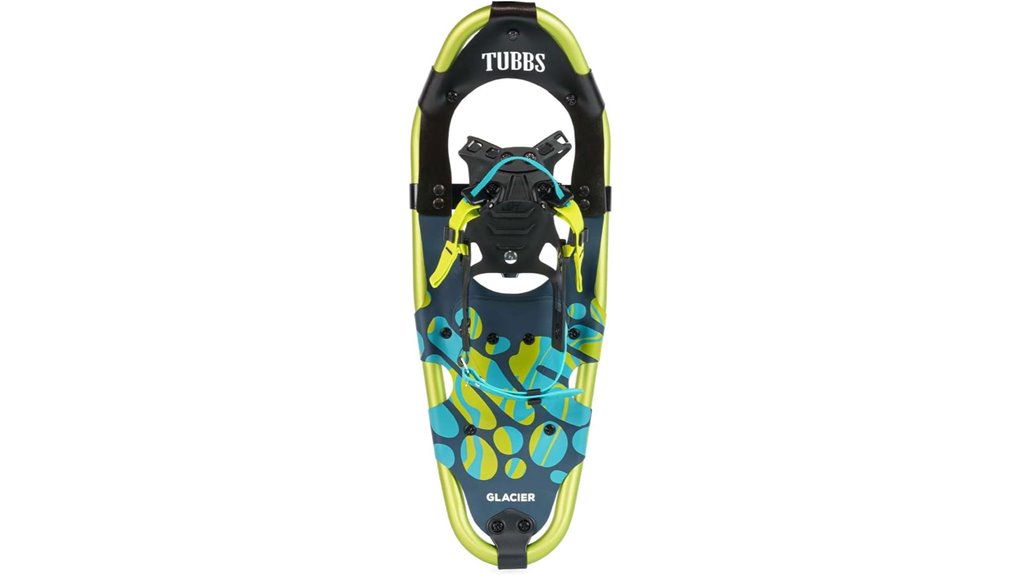
Designed for teenage family adventurers, the Tubbs Glacier snowshoes let you glide through fresh snow with confidence. They fit a narrow‑stance frame, fixed‑toe cord lets you pivot quickly, keeping control on icy trails. The Soft‑Tec deck provides deep‑snow flotation, while the Quick‑Fit binding pulls up securely without fuss. Recreational toe and heel crampons lock in place for extra grip and stability. In size 21, the blue alloy‑steel frame and aluminum deck keep the weight down to just 16 oz, or 0.448 kg. Packable at 21.5×8.2×5.75 inches, its one‑year warranty backs every adventure and keeps your carry light for explorers who value agility.
Best For: Teenage family adventurers who want lightweight, highly maneuverable snowshoes for fresh‑snow and icy trails.
Pros:
- Ultra‑light 16 oz weight for maximum agility.
- Quick‑Fit binding for a fast, secure strap‑up in any weather.
- Soft‑Tec deck and built‑in crampons provide excellent flotation and traction.
Cons:
- Only one size (21) limits fit for taller or smaller users.
- Max carry weight of 150 lbs may be restrictive for heavier backcountry gear.
- One‑year warranty is relatively short compared to some high‑end models.
https://www.amazon.com/dp/B09SLR5FYB
MSR Evo Trail Snowshoes, 22 Inch Pair, Midnight
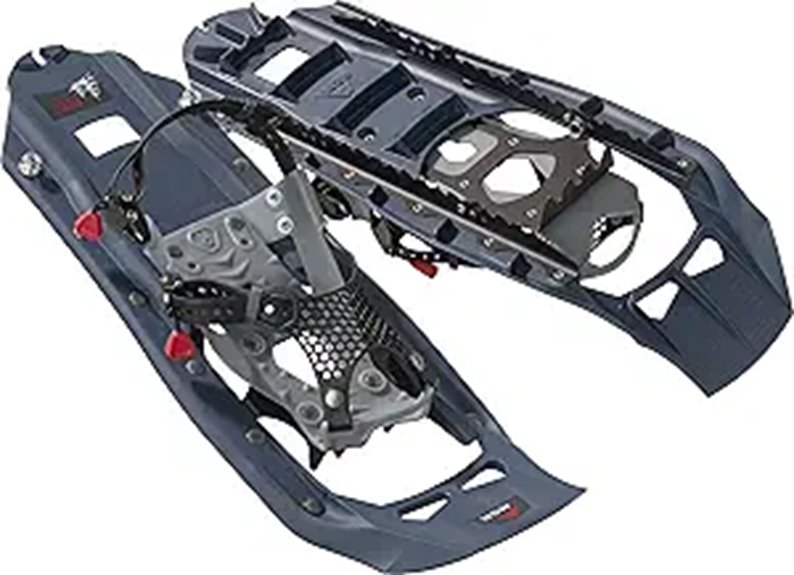
If you’re tackling moderate slopes while traveling, the MSR Evo Trail Snowshoes deliver rock‑solid grip with their steel crampons and traction rails, all while tipping the scales at just 3 lbs 10 oz.
You’ll fit them on any 3 M‑13 M or 5 W‑15 W boot, thanks to stretch‑mesh bindings that hold light hiker or snowboard tires snug. The UniBody plastic deck flexes for smooth strides yet resists wear, while the steel rails keep you stable on moderate inclines. Attachment points let you add 6‑inch tails for deep‑powder buoyancy or hauling extra gear. The whole kit stays under 1.7 kg, so it packs tight in your bag.
Best For: lightweight, versatile snowshoeing on moderate slopes for hikers, cross‑country skiers, and snowboarders who need a sturdy yet compact system.
Pros:
- Lightweight 3 lbs 10 oz (1.64 kg) frame that packs tight and feels airy on the trail.
- Steel crampons and traction rails deliver dependable grip on a variety of moderate inclines.
- Flexible UniBody plastic deck with built‑in attachment points for optional 6‑inch powder tails and extra load capacity.
Cons:
- Tail attachments must be purchased separately, adding cost and extra gear to carry.
- Max recommended load of 180 lb limits carrying capacity for heavy‑loaded expeditions.
- Designed primarily for moderate slopes; performance on steep or deep powder terrain is not its focus.
https://www.amazon.com/dp/B0B5B9MNL3
Atlas Helium Trail Snowshoes
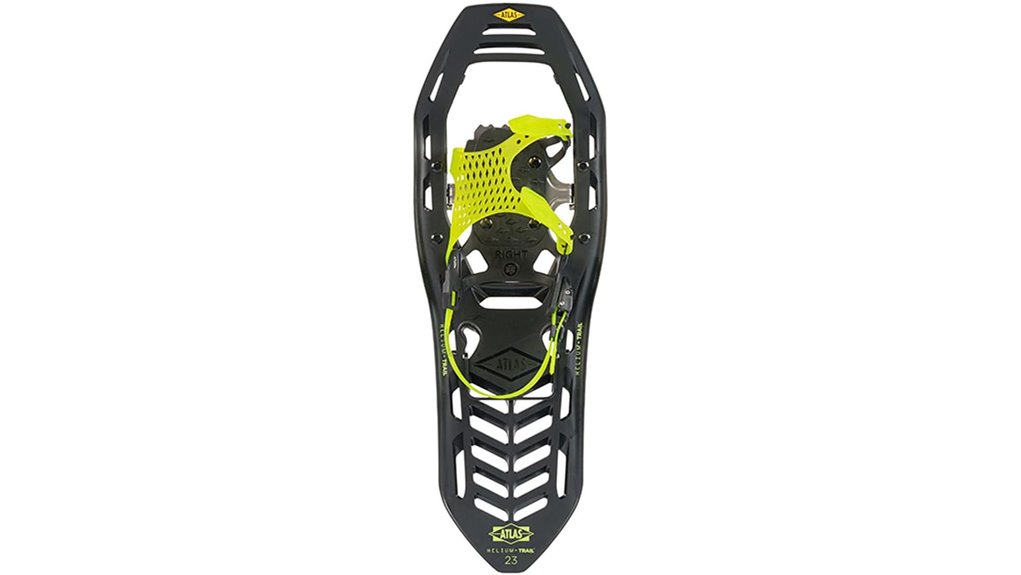
Turn training on a new level when you lace up the Atlas Helium Trail Snowshoes.
You’ll enjoy the 16‑ounce frame, which rides on any slope. Helium decking shaves off wind‑packed slush, and the traction rails cover two‑thirds of the shoe, giving you edge and stability. A 12° heel lift eases steep climbs, while ribbed runners cut snow build‑up for faster gear turnover. The stretch binding’s two‑buckle system locks in, lets you jump on, and keeps your boots snug during runs. These shoes balance performance and weight, making them ideal for beginners tackling climbs or sprint runs on thawed trails.
Best For: unisex adult beginners who need lightweight, stable snowshoes for climbing or sprint runs on thawed trails.
Pros:
- 16 oz lightweight frame reduces fatigue and eases long ascents.
- Two‑thirds traction rails give excellent edge and stability on moderate slopes.
- 12° heel lift and stretch‑binding system provide comfortable climbs and secure, quick‑entry fit.
Cons:
- Limited warranty and single black color offer little customization.
- Ribbed aluminum runners may be less durable than steel for heavy use.
- Primarily tailored for beginners; advanced trekkers may find the lightweight build and lack of downhill‑specific features lacking.
https://www.amazon.com/dp/B09SLS3HWT
Atlas Snowshoes Tote Bag
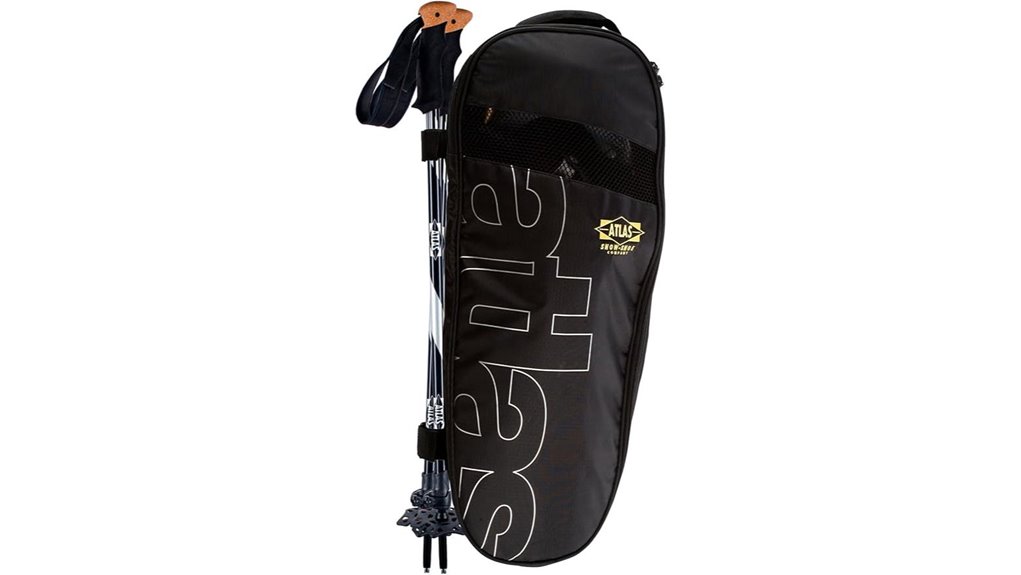
The Atlas Snowshoes Tote Bag’s roll‑top closure and hard‑shell design make it a dependable travel companion for on‑trail adventures. It weighs just 0.8 lb and measures 3 × 8 × 10 in, so you can fit it in your backpack without adding bulk. The top‑loading format lets you load gear quickly, while the reinforced cleat protection keeps snowshoes safe. A handy stash pocket keeps your map and compass within reach. The adjustable shoulder strap distributes weight evenly, ensuring comfort on long hikes. Released in 2013, this unisex tote remains a reliable, easy‑to‑carry solution for every snowshoe traveler. It will fit snugly inside any pack comfortably.
Best For: trekkers who need a lightweight, durable tote to carry snowshoes, gear, and essentials on winter treks.
Pros:
- Slim, 0.8 lb construction keeps pack weight down.
- Roll‑top and top‑loading format allow quick access and protect gear on the trail.
- Reinforced cleat‑protection and hard shell guard against damage in harsh conditions.
Cons:
- Single compartment limits internal organization for multiple items.
- No padded straps or back panel, which can reduce comfort on longer hikes.
- Expandable only at the top; no flexibility for larger or irregular loads.
https://www.amazon.com/dp/B00BGETTCO
G2 Lightweight Snowshoes with Poles Set
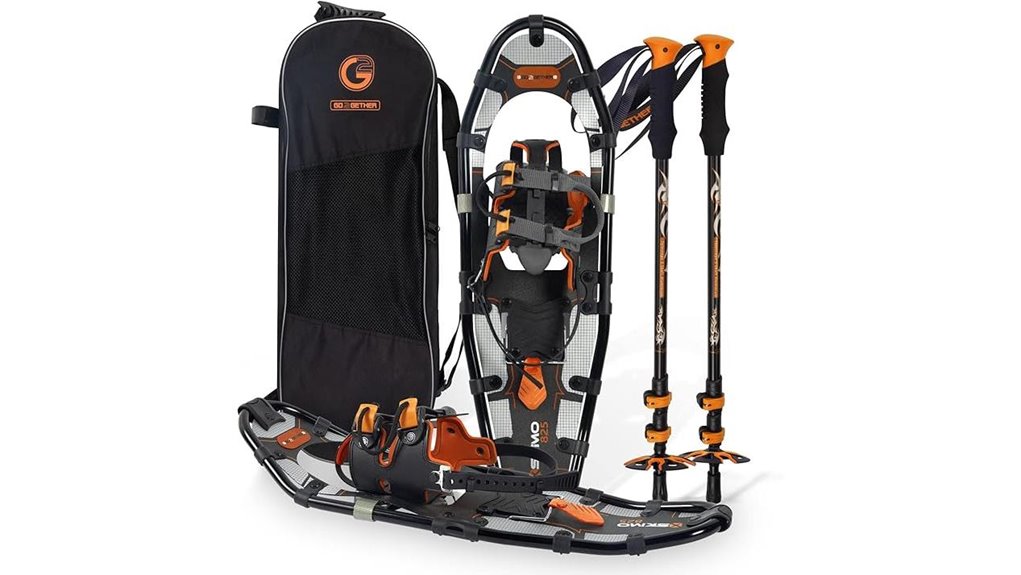
For the adventurous traveler who wants to glide through fresh snow without lugging bulky gear, the G2 Lightweight Snowshoes deliver bright orange, blue, or red decks made from high‑density polyethylene and a lightweight aluminum frame that keeps the total weight under 3 kg. Choose 21‑, 25‑, or 30‑inch models that support up to 150 lb. The EVA‑foam footpad keeps feet warm, while one‑pull nylon bindings clamp fast in cold hands. Sharp aluminum crampons provide traction on ice, and built‑in snow baskets boost buoyancy for deep snow. Trekking poles and a compact bag fit flat for easy carry and a carry strap now.
Best For: adventurers who want a compact, quick‑to‑assemble set for powdery snow and easy transport.
Pros:
- Ultra‑light weight (under 3 kg) with a one‑pull nylon binding for rapid setup, even with cold hands.
- Durable HDPE deck and aluminum frame give great buoyancy and traction, with sharp crampons for icy conditions.
- Included trekking poles, carrying bag, and snow baskets make packing and deployment hassle‑free.
Cons:
- Maximum load capacity of 150 lb limits use for heavier trekkers or those carrying extra gear.
- Only available in 21‑, 25‑, and 30‑inch sizes; may not fit very short or tall feet comfortably.
- No integrated harness or ventilation system, which could be a drawback on very cold, windy climbs.
https://www.amazon.com/dp/B08ZXMTLN5
G2 30″ Yellow Snowshoes, Poles & Tote Bag
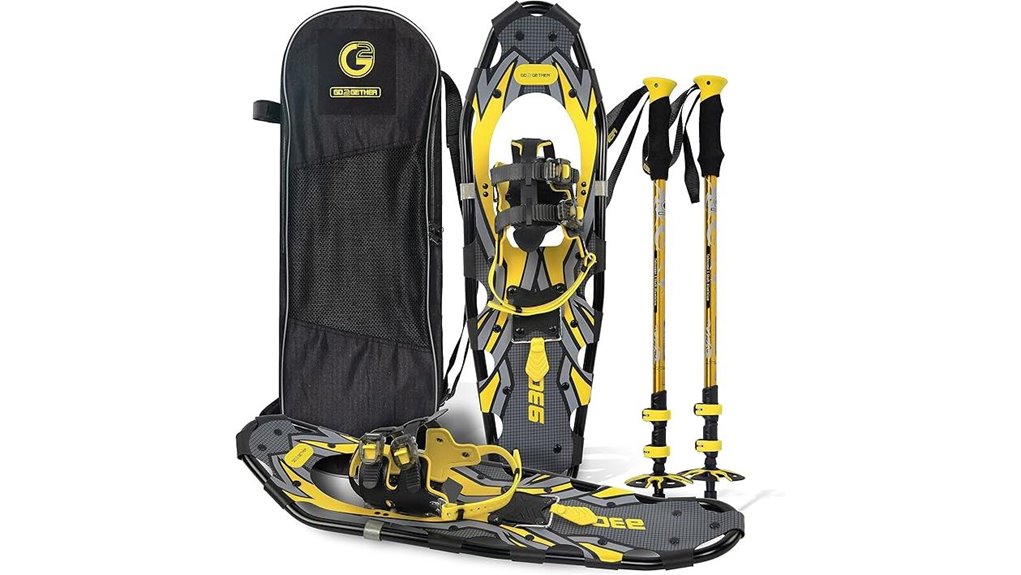
If you’re planning a winter trek and want gear that travels as well as performs, the G2 30‑inch Yellow snowshoes are a smart pick. Packable at 30 inches, they fit neatly into any backpack, yet weigh just 3.31 kg (7 lb) for the whole set, so you don’t trade speed for stability. Its design keeps you comfortable: EVA‑padded bands, a flex pivot bar, and a heel lift promote a natural gait, even on uphill slopes. Quick‑draw one‑pull buckles slide smoothly in cold, while sharp aluminum crampons give you reliable traction on ice and packed snow. Enjoy effortless packing and unmatched performance.
Best For: a winter trekker who wants lightweight, packable snowshoes that deliver a comfortable natural gait and reliable traction across diverse snow conditions.
Pros:
- Lightweight and packable (3.31 kg for the whole set) for easy backcountry travel.
- EVA‑lined bands and a heel lift promote a natural, energy‑efficient gait, even uphill.
- Sharp aluminum crampons give reliable traction on packed snow and ice.
Cons:
- Only a 30‑inch width, which may not accommodate very wide feet.
- Aluminum frame and binding may seem less durable than full‑metal options.
- Adds weight to multi‑day packs, potentially affecting overall load.
https://www.amazon.com/dp/B0BXD46RH4
Yukon Charlie Spin Float Women’s Snowshoe Kit
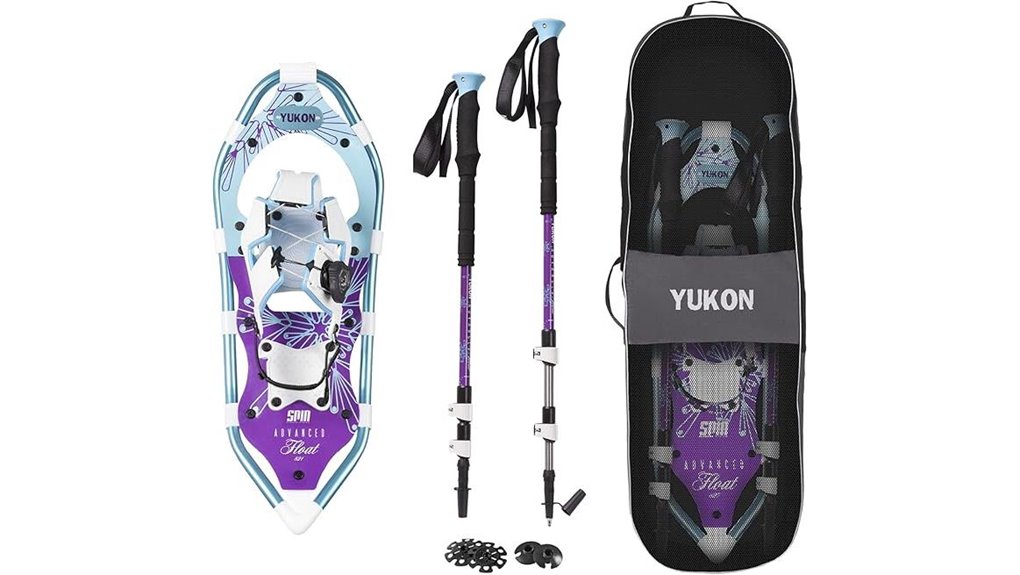
This Yukon Charlie Spin Float kit is ideal for veteran female hikers who weigh 100‑150 lb and seek a lightweight, high‑performance snowshoe for back‑country exploration. It weighs just 3.4 lb for the snowshoes, and the whole kit totals 7.2 lb—perfect weight for your pack. The 8‑in × 21‑in aluminum frame fits comfortably under a mid‑label pack, while the SPIN by Northwave Dial binding keeps tension tight yet adjustable for any foot. Rocker V‑tail technology lets you glide smoothly from easy stroll to high‑speed sprint, and the latest axle system offers reliable traction on packed ice. Bright purple and chrome teal shafts boost night visibility.
Best For: avid women back‑country hikers who weigh 100–150 lb and need a lightweight, high‑performance snowshoe kit for harsh winter terrain.
Pros:
- Ultra‑light weight at just 3.4 lb for the snowshoes and 7.2 lb total, keeping packs easily manageable.
- SPIN by Northwave Dial binding and advanced axle system provide tight, adjustable fit and reliable traction on packed ice.
- Bright purple and chrome teal shafts boost visibility during low‑light conditions for added safety.
Cons:
- Maximum user weight of 150 lb limits suitability for heavier hikers.
- The kit contains only the basics (two snowshoes and trekking poles), offering no additional trail accessories.
- The one‑year warranty may feel short for expensive, long‑term outdoor gear.
https://www.amazon.com/dp/B07H7HHVCQ
G2 Snowshoes with Trekking Poles Set
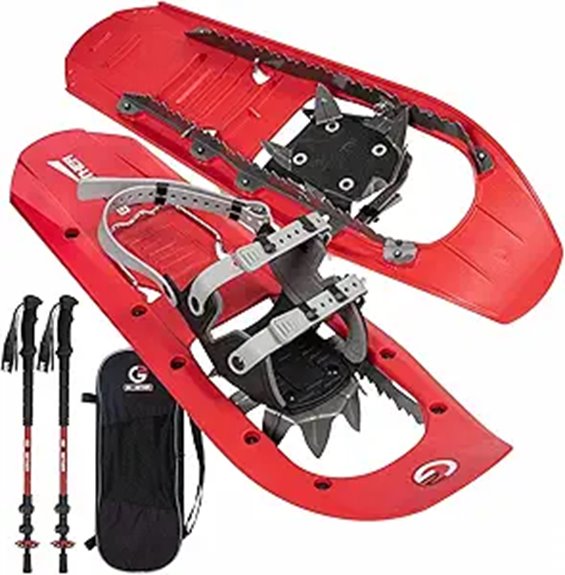
You’ll find the G2 Snowshoes for Travel is a traveller’s dream, thanks to its lightweight HDPE deck and flexible pivot bar that keep you steady on flats and uphill.
Choose from 23, 25, or 30‑inch tires that suit your stride. The alloy steel rails grip rugged powder, while the high‑quality steel crampons give you bite on icy ledges.
Inside, EVA foam cushions keep feet warm during long descents, and the one‑pull buckle lets you secure bindings faster than a scarf snaps shut. Flex your footwork with the lightweight wooden poles that glide over snow, stopping you before you slip.
Best For: Winter recreational hikers and casual backcountry trekkers who value lightweight gear and easy setup.
Pros:
- Lightweight HDPE deck keeps the overall mass low for extended hikes.
- Includes trekking poles and a tote bag, offering added stability and convenient transport.
- Bright colors and well‑designed crampons enhance visibility and traction on icy slopes.
Cons:
- Limited to smaller mountains; heavy snowpacks can overwhelm even the 30‑inch model.
- The one‑pull buckle, while quick, may slip in extreme cold or with oversized boots.
- Lacks a re‑adjustable crampon or toe‑plate system for varied terrain depths.
https://www.amazon.com/dp/B09Q5M7R7X
Factors to Consider When Choosing Snowshoes for Travel (Flat Packing)
Choosing travel snowshoes starts with their weight and how easily you can carry them, so look for models that stay light yet sturdy. Next, consider how compact they pack, the durability of the material, and whether the tread offers good traction on packed, slushy, or icy snow, all of which impact how you move through varied terrain. Finally, make sure the design includes insulation so you stay warm without overheating while maneuvering through deep, cold snow.
Weight and Portability
A key consideration for travel‑ready snowshoes is their weight. A typical pair ranges between 3 kg and 5 kg; 21‑inch models usually sit around 3 kg, while 25‑ and 30‑inch shoes approach 5 kg. Add the empty carrying bag—200 to 300 g—and you’re looking at roughly 3.5 to 5.3 kg for a full kit. Using aluminum frames or HDPE decks cuts shoe mass by 20–30 % versus wood, making day‑packing easier. Remember the poles; a telescoping pair adds 0.25 to 0.5 kg, so choose length wisely for maximum portability. A smart heel‑lift or foot‑binding system can also trim bulk, keeping the setup lighter and faster to load. Count each gram, and if you’re hiking just a day, choose the lightest frame. For multi‑day trips, add a padded mat to protect without extra weight.
Packable Footprint Size
The footprint of a snowshoe—its length‑by‑width in inches—directly determines how effectively it can lay flat in a pack. Because the snowshoe’s width stays close to 8 inches, its front‑to‑back profile stays slim, letting two units sit densely inside a 28‑L backpack. A 25‑inch model packs up to about 18 inches when compressed, shrinking 75‑80 % of its usable length while the air‑filled tread keeps its shape. In contrast, a 30‑inch pair covers roughly 90 sq in, pushing it 30 % larger than a 25‑inch shoe; the bulk rises, and the pack weight climbs if you need extra padding. Selecting a shallow‑depression tread on a lightweight, low‑profile frame keeps each shoe under 4 lb, so you can store two without bulging or compromising flotation on packed surfaces. When you fold them side‑by‑side, the 18‑inch compressed length plus bag padding fits neatly between your gear, leaving room for other essentials.
Material Durability Considerations
Because durability decides how long your snowshoes will keep performing, you’ll want to compare how each component holds up under stress, temperature swings, and abrasion. Ultra‑light aluminum frames block corrosion and stay solid for hundreds of miles, yet they can fracture in extreme cold. HDPE decks add impact tolerance and long fatigue life; they support heavy powder while staying under four kilos each. Pongee gaiters offer waterproofing, tear and puncture defense, extending life on rough trails. Frame alloys like 6000‑series Al‑Si‑Mg give the best strength‑to‑weight ratios, whereas titanium shines but adds cost and modest weight. Polymer‑reinforced laminated skins protect the outer surface without sacrificing flexibility, preventing creep on uneven snow. Choosing the right combo keeps your pack lighter and lets you traverse longer distances without repair stops.
Traction in Varying Snow
Durability matters, but traction hinges on how the foot‑shoe interface combats the unpredictable snow conditions. Steel crampons with sharp points boost traction on icy slopes up to 80% compared to non‑crampon shoes, as shown in controlled snowpack tests. Saw‑tooth tread patterns spaced at 1 cm intervals grant edge grip on melt‑water‑slicked snow, cutting slip rates by roughly 25% below smooth‑sole shoes. Aluminum louvered tread plates reduce snow buildup by about 30% on slopes, enabling footing at very tilt angles up to 25°. Hydro‑coated rubber loops around the heel form micro‑porous channels that disperse meltwater, preserving traction even when temperatures sit below 0 °C during outdoor hikes. A pivot‑bar that flexes 12 mm under load spreads traction forces across the shoe, boosting stability on snow while keeping flotation.
Insulation for Cold Protection
When you pick snowshoes for flat packing, the right insulation keeps your feet warm and your strides steady. Lining the board with low‑thermal‑conductivity foam or felt can cut heat loss by up to 30 percent compared to bare shoes. Lightweight foam skins, with R‑values of 0.5–1.0, offer a thin barrier that resists wind chill. Micro‑fiber or engineered textiles trap air in micro‑pockets, providing an extra 15–20 percent of warmth over the trek. A moisture‑wicking outer layer paired with a non‑absorbent inner liner stops condensation from forming inside, which would otherwise chill you. Detachable insulated covers let you tweak thermal protection for anything from mild to brutal winter conditions. Keep your inventory light, yet feel confident tackling slopes, lakes, and steamy trails where cold bites daily.
Ease of Setup
After you’ve kept your feet warm with the right insulation, the next step is to go from pack to stride in a flash. One‑pull ratchet bindings lock your boot into the shoe in roughly five to ten seconds per foot, cutting setup time from a 30‑second “tight‑strap‑then‑adjust” routine to under 15 seconds total. Adjustable telescoping poles lock between 25.5 and 54 inches in under a minute—no tools needed—so everyone can stand up and go right away. A 12° heel‑lift keeps your boot elevated, reducing the need for readjustments while climbing. The flat aluminum frame snaps onto any 7½‑to‑13‑inch boot in three to four seconds, eliminating lacing steps. Together, these features let you load or reload the whole set in less than half a minute.
Storage and Travel Bags**
Because you’ll need to carry a 25‑inch snowshoe and its poles in tight spaces, the bag’s dimensions are key—look for at least a 28‑liter volume and roughly 28 × 6 × 6 in to avoid compression. Choosing a PFAS‑free DWR coating doubles how long the snowshoe stays dry after heavy snow. Built‑in mesh ventilation panels and a drain grommet let excess moisture escape, keeping mold at bay during off‑season storage. A small, secure hook‑and‑loop strap on the exterior lets you fasten a full pair of trekking poles, so the gear stays together and avoids strap damage. Keep the bag’s weight under about 0.45 kg (12 oz) to reduce your overall load, especially when climbing uneven terrain. Compact design and durable zippers further guarantee reliability without adding bulk. It keeps everything organized.
Häufig gestellte Fragen
How Often Should I Clean My Flat-Packed Snowshoes?
You should clean your flat‑packed snowshoes after each long outing, especially if you’ve trekked on muddy or dusty trails. Removing loose dirt first helps avoid grit settling into the seams. Scrub the frame lightly with a damp cloth, rinse, and let them air dry completely before packing. A quick wipe‑down every few weeks keeps your gear fresh and extends its life. Feel confident you’ll enjoy trouble‑free adventures on the trail.
Can I Use Flat-Packed Snowshoes on Steep Slopes?
You’ll find flat‑packed snowshoes reliable on steep slopes, but they’re tailored for cross‑country rather than alpine edginess. Picture a longboarder carving a downhill: the board glides, but any abrupt turn can send it spinning. Similarly, your snowshoes will slide if you lock your knees. On a 30‑degree pitch, you’ll manage on packed tracks, yet switchbacks and loose powder may demand sturdier, fixed‑shoe gear, and glide with grace and stay steady.
What Winter Wear Is Best With Snowshoe Packs?
You’ll want insulated, breathable layers that stay light while you’re carrying your flat‑packed snowshoes. Start with a moisture‑wicking base layer, layer a mid‑layer fleece or lightweight down, and finish with a wind‑and‑water‑proof shell that lets you breathe. Add a packable thermal hat, gaiter, and grease‑proof gloves to keep everything warm and dry without bulk.
You should consider a down vest for warmth on climbs, and breathable shoes to reduce fatigue.
Do Flat-Packed Snowshoes Need Special Packaging During Travel?
Imagine you glide over fresh snow—do flat‑packed snowshoes need special packaging during travel? Yes, you’ll benefit from smart packaging. Slip them into a reusable gear sleeve or padded tube, then secure with strap‑tied zip‑lock bags. This shields them from bumps, keeps your pack neat, and lets you enjoy crisp steps without hassle. You’ll thank your backpack for the extra room and ease while trekking highways, you stay prepared and covered.
Is It Safe to Rig a Tripod on Flat-Packed Snowshoes?
Yes, you can safely rig a tripod on flat‑packed snowshoes. The boards are lightweight and stable, so they’ll hold the frame’s weight without deformation. Secure the tripod feet snugly, use the same mounting points intended for ski poles, and keep the snowshoes flat on a firm surface. Avoid overloading the frames, test balance first, and you’ll get steady shots, preserving the equipment’s integrity during travel for lasting durability.
Schlussfolgerung
By switching to flat‑pack snowshoes, you’ll keep your pack lighter and your feet happier. Research shows that these designs cut pack space by nearly 30 %, giving you an extra 500 m of trail for the same weight. You’ll feel the difference on each ascent—no more bulky carriers or awkward angles. When you’re ready, try one of the models above, pack it flat, and enjoy a new level of freedom and let your adventures soar higher today.
collapsible snowshoes, Lightweight Gear, winter backpacking
 German
  English
  French
  Italian
  Spanish