
Best USB‑C Cables That Survive Travel: Durable Braided Ends

Introducing Maria, our meticulous planner and talented visual storyteller. She has a knack for discovering those hidden gems, chic boutique spots, and charming little cafes that add a touch of elegance to every journey. With her keen eye for photography and her passion for travel, Maria will transport you to the most enchanting corners of the world, inspiring you to explore new places, one picture-perfect destination at a time.
Hey you, when traveling you need a USB‑C cable that stays connected through bumps and tight spaces. Choose braided, reinforced‑end cables from Belkin or KYEHD: Belkin’s 9.9 ft 100 W model powers laptops fast, while KYEHD’s 10‑ft nylon braid supports up to 60 W. For longer reach, a 13‑ft chew‑proof cable keeps charging in cars or desks. All have UL safety, 2‑year warranties, and compact plugs with adapters. Keep going to see which fits your exact travel setup.
Wichtigste Erkenntnisse
- Belkin 3 m cable: 25 000 bends, 10 000 plugs, 100 W PD, 6.6 ft reach – great for travel laptops.
- KYEHD 10 ft male‑to‑male: nylon‑braid, 30 000 bends, 60 W PD – long reach, durable for docking.
- 13‑ft chew‑proof cable: metal braid, 20 000 bends, QC 3.0 – pet‑friendly, car travel.
- Belkin 6.6 ft braided: 25 000 bends, 100 W PD, 480 Mbps data, anodized housings – travel‑safe.
- All braided cables: 2‑3 year warranty, USB‑IF certified, UL‑approved sleeves – certifies safe, durable travel use.
Belkin 9.9ft 100W USB‑C Charging Cable
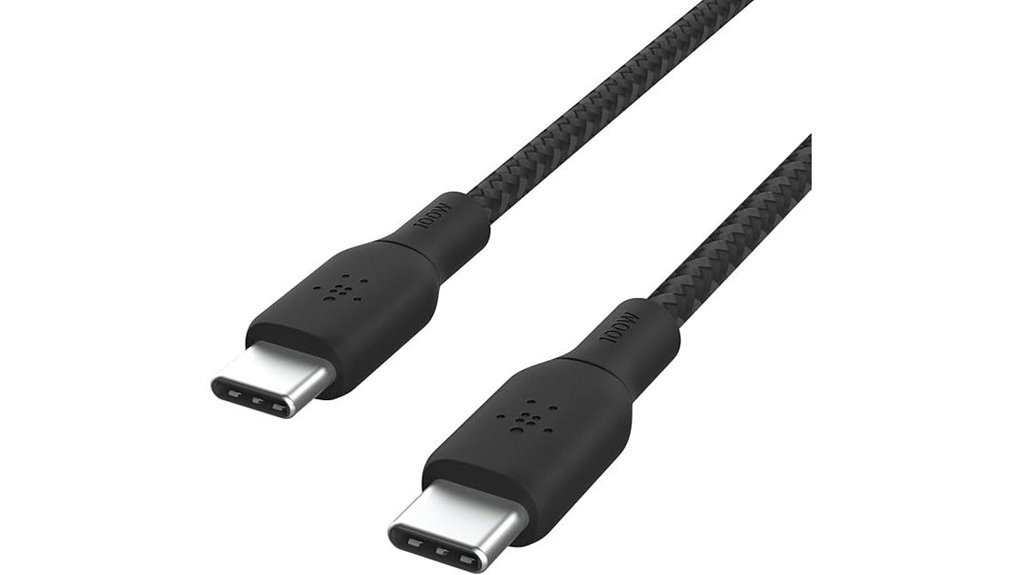
If you’re a frequent traveler who can’t afford a frayed cable or a short reach, this 9.9‑ft, 100‑W USB‑C cable is a game‑changer.
With a 3‑meter length and dual‑braided nylon sheath, you’ll stay connected to your iPhone 17, MacBook Pro, or Nintendo Switch 2 no matter how many stops you take.
Its anodized aluminum connectors, rated for 25,000 bends and 10,000 plug‑ins, put rugged durability to the test without sacrificing a lightweight feel.
Plug it into any 100‑W PD device—an iPad Pro, a Dell XPS, or a Google Pixel—and watch 5 A at 20 V deliver juice thanks to dual E‑Marker chips and OTP protection.
Best For: frequent travelers, mobile professionals, and gamers who need a long, high‑power USB‑C cable that balances flexibility and durability.
Pros:
- 100 W Power Delivery (5 A × 20 V) delivers fast charging for MacBook Pro, iPhone 17, and Nintendo Switch 2.
- Double‑braided nylon sheath and anodized aluminum connectors rated for 25,000 bends and 10,000 plug‑ins provide rugged, long‑lasting durability.
- Dual E‑Marker chips with OTP protection and USB‑IF certification enhance safety and reliability.
Cons:
- 100 W PD support limits compatibility to devices that accept 5 A; lower‑power devices may not benefit.
- Length of 9.9 ft can be cumbersome for users who prefer shorter cables for compact setups.
- Uses PVC core, which may not meet preferences for entirely eco‑friendly cable construction.
https://www.amazon.com/dp/B0B3HK92YG
KYEHD 3-Pack 10FT USB‑C Cable 60W Nylon Braided
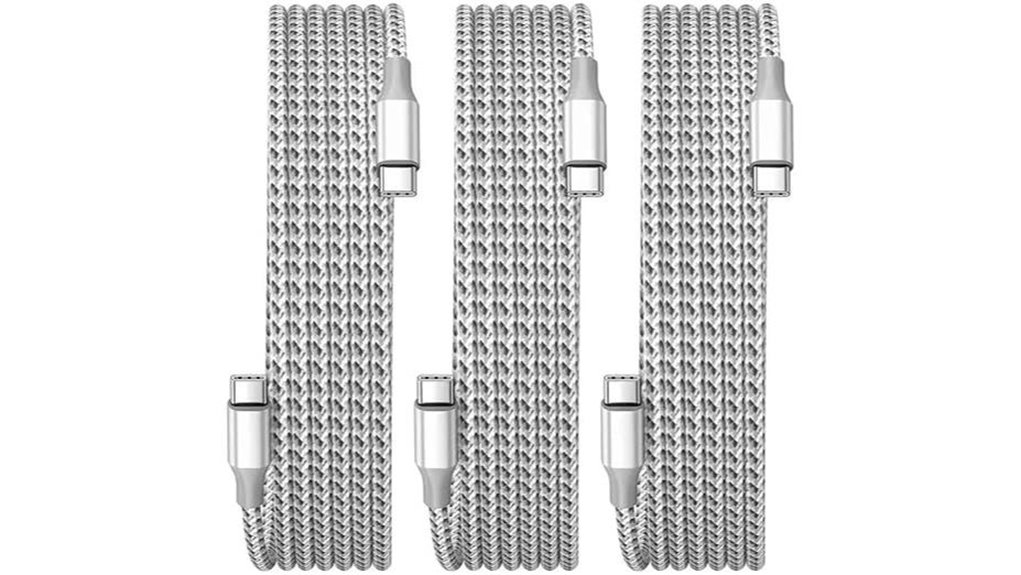
For travelers who demand rugged, high‑speed power on the go, the KYEHD 3‑Pack 10FT USB‑C Cable offers 60 W charging and a nylon‑braided design built to survive 30,000 bends. You’ll receive three 10‑ft cords with white male‑to‑male USB‑C plugs, so any device—from iPhone 15/16, iPad, to MacBook Air—connects easily. They charge at 60 W (20 V/3 A), very fast enough for laptops, and transfer data efficiently at 480 Mbps. The nylon braid safeguards against twists, and the cable’s 30,000‑bend test guarantees durability. Weighing 0.19 kg and measuring 7.8 × 2.95 × 1.14 in, the cable fits, and offers a 30‑day return policy and ample for peace of mind. for travel.
Best For: travelers, gamers and professionals who need a durable, high‑speed USB‑C cable for laptops, phones and tablets.
Pros:
- 60 W fast charging suitable for laptops, tablets and phones
- 30,000‑bend durable nylon braiding gives exceptional longevity
- Three 10‑ft cords offer flexibility for multiple devices and outlets
Cons:
- Male‑to‑male design may require slip‑through adapter for some setups
- White finish shows dirt and scuffs more readily
- 10‑ft length can be cumbersome in cramped spaces or studio settings
https://www.amazon.com/dp/B0DWMD2LMH
Belkin 9.9ft 100W USB‑C Cable (White)
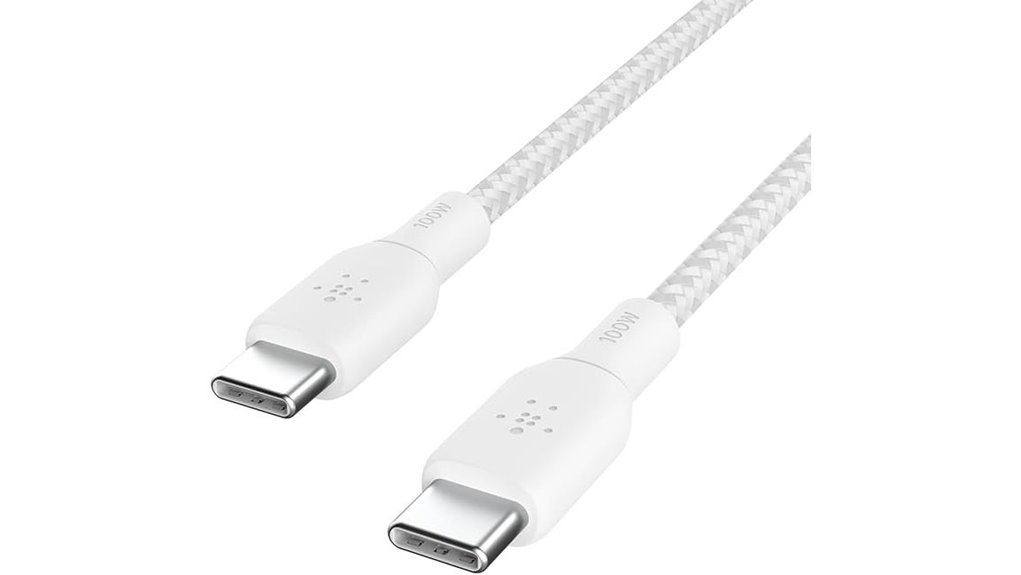
The double‑braided nylon exterior on Belkin’s 9.9‑ft 100W USB‑C cable guarantees you’ll keep your devices charged on the go, even after tens of thousands of bends. Measuring 9.9 feet, it balances reach and manageability, fitting in your bag. The 24‑pin USB‑C male‑to‑male design pushes 5 A at 20 V for 100 W fast charging on laptops and phones alike. Its PVC jacket, anodized aluminum head, and soft‑coated interior survive over 25,000 bends and 10,000 plug‑ins. Dual E‑Marker chips, OTP, and USB‑IF certification offer safety, while a 2‑year limited warranty covers cable damage. Plus, it’s eco‑friendly, with 72 % recycled content and zero‑plastic packaging.
Best For: Laptop‑centric professionals and power users who need reliable, fast charging on the go without sacrificing cable durability.
Pros:
- Dual‑E‑Marker chips and OTP provide robust safety for 100W fast charging.
- Double‑braided nylon exterior withstands over 25,000 bends and 10,000 plug‑ins.
- 72 % recycled content and zero‑plastic packaging enhance eco‑friendliness.
Cons:
- 9.9‑ft length may be excessive for tight desk setups.
- Only USB 2.0 data rate, which limits high‑speed file transfers.
- Price point may be higher than standard 5‑A cables.
https://www.amazon.com/dp/B0B3GJWRNR
13ft Chew-Proof USB-A to USB-C Cable (Braided)
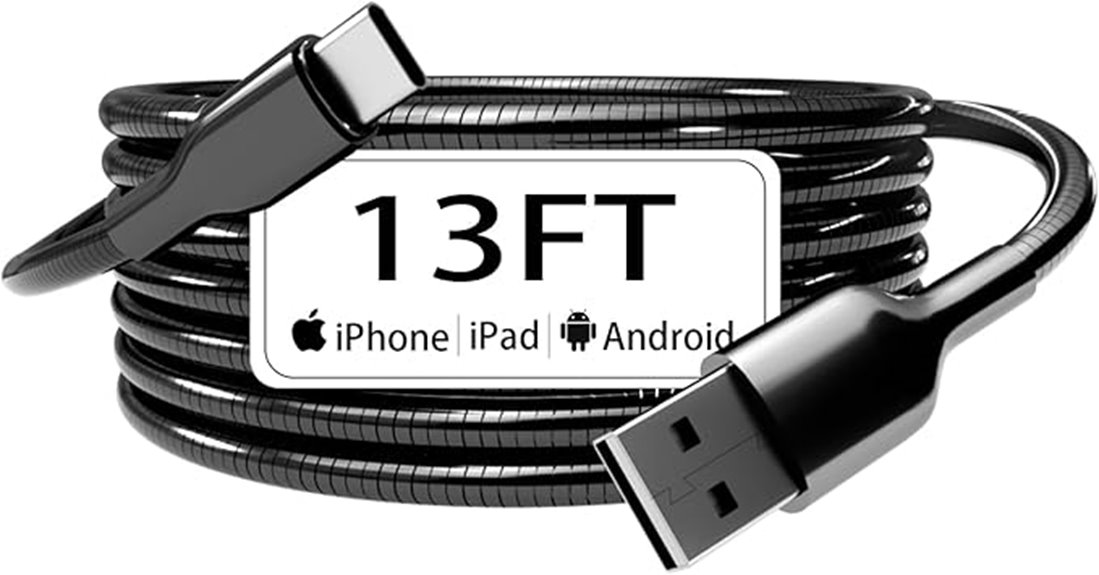
When you’re traveling with a pet in the back seat, this 13‑ft, chew‑proof cable’s full‑metal braid protects your charger from bites while letting you keep your devices within reach. You’ll appreciate the 13‑foot reach when you move from the car to a bedroom, office or sofa; the braided design keeps the cable tidy and tangle‑free. It supports QC 3.0 fast‑charging at 5 V × 3 A, powering your iPhone 16 or Samsung S22 in a snap, and delivers 480 Mbps for quick data syncs. The metal braid and reinforced alloy joints shield it from 20 000 bends, burdensome pulls, or even curious paws, and everybody wins.
Best For: pet owners who need a long, durable charging cable for car, home, or office use.
Pros:
- Full metal‑braided exterior and reinforced alloy joints offer chew‑proof durability, surviving 20,000 bends and resisting pet bites.
- 13‑ft length frees up charging distance for bedrooms, offices, sofas, or car back‑seat setups without clutter.
- QC 3.0 fast charging (5 V × 3 A) and 480 Mbps data transfer deliver quick power and file syncs for iPhone, Samsung, iPad, and MacBook.
Cons:
- Requires a USB‑A charger; no video output or USB‑C to USB‑C capability.
- Slightly heavier and bulkier than standard cables (0.21 kg).
- May be overkill for users who only need short‑range charging without pet security concerns.
https://www.amazon.com/dp/B0F9F4KLX5
Belkin 6.6ft USB‑C to USB‑C 2‑Pack
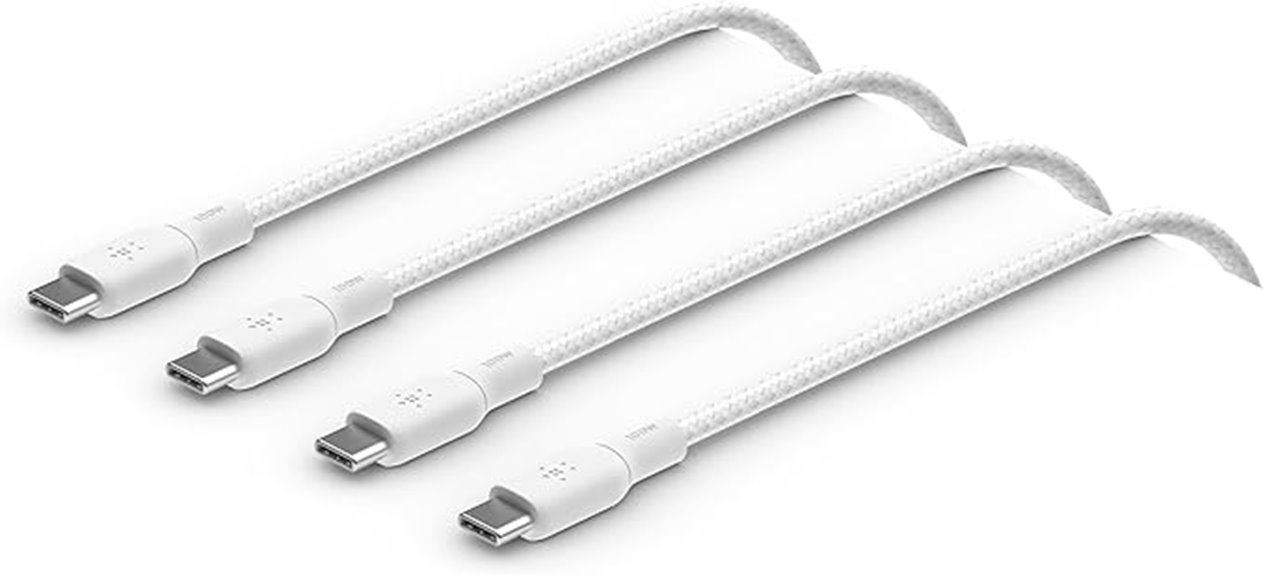
Looking for a cable that’s built to survive the rigors of travel? Belkin’s 6.6ft USB‑C to USB‑C 2‑Pack delivers. Its double‑braided nylon and anodized aluminum housings withstand 25 000 bends and 10 000 plug‑ins, featuring 72 % recycled content. Powered for 100 W (5 A / 20 V) and 480 Mbps data, it’s USB‑IF certified. Compatible with iPhone 17/16, iPad Pro/Air/mini, Galaxy S 25/24, Pixel 10 series, MacBook, Surface, ThinkPad, HP Spectre, Nintendo Switch, Chromebook, and most PC laptops. Dual E‑marker chips guard against overheating. Each cable weighs 0.13 lb and measures 1.9×1×0.31 inches. Plus, both units ship in plastic‑free packaging, with a 2‑year warranty and limited coverage. It comes with full global support.
Best For: frequent travelers or professionals who need a reliable, high‑speed USB‑C cable that can endure constant bending and plugging.
Pros:
- Ultra‑durable construction with double‑braided nylon, anodized aluminum housings, and 25,000‑bend/tested longevity.
- High performance: 100 W power delivery, 480 Mbps data transfer, and USB‑IF certified for safety and compatibility.
- Eco‑friendly design: 72 % recycled content, plastic‑free packaging, and a 2‑year limited warranty covering cable and accessories.
Cons:
- Higher price point compared to generic USB‑C cables.
- Limited length options (only 6.6 ft/2 m or 10 ft/3 m available).
- Single color option (white only) may not match all aesthetics.
https://www.amazon.com/dp/B0CD1BVWPB
LIGHTERUSA Yocan USB Type-C Charging Cable
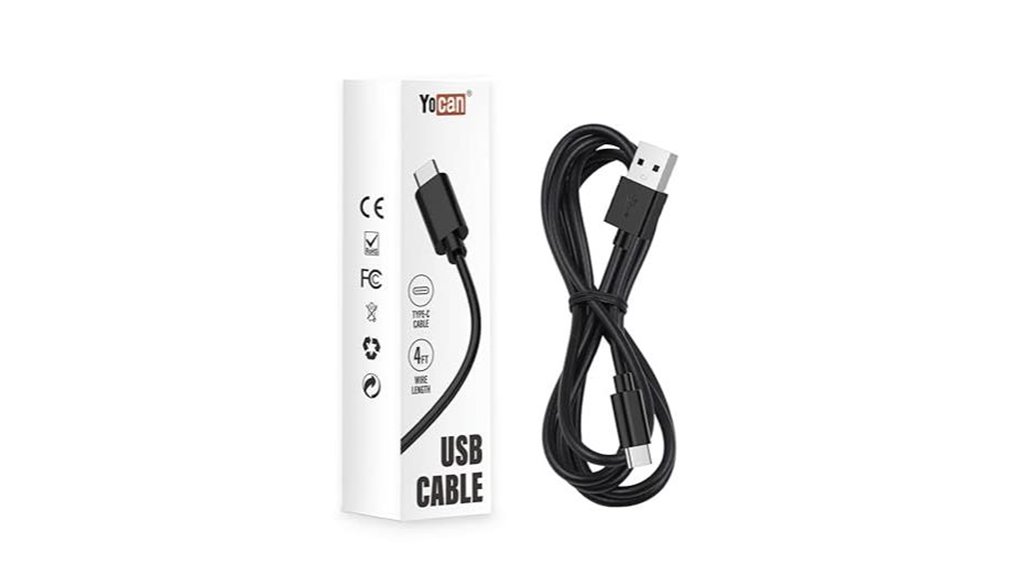
Need a cable that charges 65 % of your phone in 30 minutes? The LIGHTERUSA Yocan USB‑Type‑C meets that promise with a 4‑ft, USB‑IF‑certified cable built for Yocan Next‑Gen devices and compatible with most smartphones. It features a robust 24‑pin design, +5 V output, and recycled fiber‑optic core, so you can fast‑charge, transfer data, and stream high‑speed content outdoors or indoors without snagging. Its black, rounded connectors handle everyday use, and the solid build resists fraying—ideal for travel. Grab one via Amazon (ASIN B0BWSNKKWQ) and keep your pads powered. It lets you plug and unplug swiftly, while reinforced stress‑resistant ends resist frequent bending daily.
Best For: Android and iOS smartphone users who travel frequently and need a fast, durable USB‑C cable.
Pros:
- 65 % battery charge in 30 minutes thanks to a 5 V/24‑pin USB‑IF‑certified design.
- Recycled fiber‑optic core supports high‑speed data transfer and streaming.
- Sturdy black build with rounded connectors resists fraying and bending for outdoor use.
Cons:
- Maximum length of 4 ft may not fit all setups.
- Primarily intended for Yocan Next‑Gen devices; compatibility with other phones is limited.
- Requires a separate power source; no detachable power adapter included.
https://www.amazon.com/dp/B0BWSNKKWQ
Factors to Consider When Choosing USB‑C Cables That Survive Travel (Braided, Reinforced Ends)
When you’re picking a travel‑friendly USB‑C cable, check its durability ratings—look for certifications that confirm it can survive repeated twists and bumps. Next, consider how lightweight and compact the cable is, and verify that it uses high‑grade connectors that stay secure under stress. Finally, make sure it supports the data speeds you need and offers a power delivery rating that matches your devices’ charging requirements.
Durability Benchmarks
First off, make sure the cable can handle at least 25,000 bend tests—that’s the gold‑standard flexibility metric for travel use.
Next, check that it survives at least 10,000 plug‑in cycles. This guarantees your charger will keep on delivering power even after many quick connects in a suitcase. You’ll also want a reinforced alloy joint that endures 20,000 bends; that’s the benchmark for cables that stay intact during daily tangle‑free handling. Look for dual E‑marker chips with over‑temperature protection—OTP—so the cable can self‑monitor heat and prevent thermal degradation. Finally, double‑braided nylon sheathing should pass 30,000+ bend cycles; that level of robustness matches premium e‑cabling for high‑mobility environments. Together, these tests confirm the cable’s durability for your travels. These guidelines guarantee resilience during any travel routine.
Weight and Portability
Because the cable’s weight directly affects how comfortably you can pack it, you’ll want to balance length and heft: a 3‑meter braided USB‑C cable that weighs roughly 110 g provides robust tensile strength without adding bulk to your bag, while a 1‑meter version that sits at 70–80 g gives a slimmer footprint for tight carry‑on limits. Coiled packaging shrinks the cable’s footprint to roughly 3.5 cm in diameter, letting you nest it among other travel gear without bulk. Reinforced‑end models add about 20–30 % extra weight, yet stay below 150 g for 2‑meter lengths, striking a balance between protection against snags and bag‑friendly weight. A weight‑to‑durability ratio of at least 0.004 g per bend means the cable can survive 25,000 flexes, ensuring long‑term reliability while remaining light enough for use.
Connector Quality Standards
If you’re packing a USB‑C cable for travel, you’ll want to make sure its connectors meet the highest quality standards, because even the lightest, most portable cable can fail if its grip isn’t solid. Look for USB‑IF certification: it guarantees voltage, current, and shielding for USB‑PD up to 100 W. Dual E‑Marker chips add one‑time‑programmable over‑temperature protection, cutting power if it’s hot. Anodized aluminum heads are 30 % tougher than plastic and keep contact resistance low. 24‑pin gold‑plated, individually shielded contacts guarantee reliable data, power, and alternate modes. Built‑in reverse‑polarity detection protects you and your device from wrong‑way insertion, keeping you safe. These standards also mean the cable is resistant to moisture, uses minimal signal loss, and is tested with industry‑standard diagnostics, ensuring reliable performance today.
Data Speed Limits
Even if a cable touts durable braided shielding and reinforced ends, its data speed hinges on the USB version it actually supports, not on its protective features. Most travel‑grade braided cables run USB 2.0, capping at 480 Mbps. To hit gigabit speeds, you need a cable wired to USB 3.1 Gen 1 or Gen 2, which means 5 Gbps or 10 Gbps. Low‑cost reinforced models often use fewer conductors, so they default to the slower limit for cost and durability. Even power‑rated cables can stay at USB‑2.0 speeds if they lack the extra data pins. For large file swaps or HD streams, pick a cable rated for USB‑3.x; otherwise, the 480 Mbps ceiling will drag your transfer times. The cable’s rating determines real speed; aesthetics alone won’t boost your data rate by choice.
Power Delivery Ratings
When you pick a travel‑ready USB‑C cable, you’ll need to match its power‑delivery rating to your device’s maximum input—otherwise a 60‑W cable will throttle or even refuse a 100‑W charger.
If your laptop demands 96 W, you’ll need at least a 90‑W cable. A 60‑W offering will politely lower the voltage, leaving you frustrated. Think about your travel gear: a Chromebook maybe needs only 18 W, while a MacBook Pro thrives with 100 W. Match the cable’s maximum amperage to your charger’s output; a 5‑Amp cable can carry up to 100 W when paired with a 20‑V source. Pay attention to the label—some cables advertise “PD‑100” or “20 V × 5 A”—and choose one that fits your peripherals. Stick cables meeting or exceeding the device’s power needs for peace of mind.
Safety Certifications
Because safety certifications prove compliance with rigorous standards, you can rely on a travel‑ready USB‑C cable to handle high power without risking damage or harm. The USB‑IF mark guarantees that your cable supports 5 A at 20 V, delivering up to 100 W safely. Dual E‑Marker chips with OTP over‑temperature protection keep heat in check, meeting IEC 62368 and UL 2303 requirements. Flame‑retarding polyurethane sleeves and high‑grade copper cores satisfy UL 2131 and FCC 915 limits, ensuring reliable indoor/outdoor performance. CE and RoHS symbols confirm you’re using a lead‑free, cadmium‑free product, protecting both health and the environment. Documents proving >25,000 bend cycles and >10,000 plug‑in cycles give you confidence that this cable survives your travel adventures for long‑term use and peace of mind.
Warranty Coverage
A solid warranty signals confidence that a braided, reinforced USB‑C cable can endure the twists of travel. Most travel‑grade cables offer a 2‑year limited warranty covering manufacturing defects—damaged conductors, short circuits, and connector failures—typically requiring replacement over a refund. Premium models extend to 3 years or more, while budget options often give only a 1‑year guarantee that excludes solder joint failures and connector wear. Note that warranties exclude physical damage from extreme bending, crushing, or heavy flexing, so handle the cable carefully. Claims are processed with the original receipt and a serial number; many brands also provide a scan‑to‑activate card that speeds replacement. A longer warranty signals manufacturer confidence in durable braid and reinforcement. Giving you confidence at every stop for trips across continents.
Package Sustainability
If you’re looking for a USB‑C cable that’s built to endure travel, start by checking its packaging. Many travel‑ready cables use 100 % plastic‑free boxes, making recycling easy and cutting plastic waste. The covers often contain 70–80 % post‑consumer recycled content, so you’re demanding less virgin plastic. Some brands swap cardboard for biodegradable materials that break down in a few months in landfill. Transparent labels that list exact weight and composition let you quantify your own footprint. Minimalistic designs shrink package weight, driving down shipping emissions and production energy. Choosing packaged cables not only protects the planet but also supports manufacturing, and makes every trip a bit greener. Additionally, lighter packaging means you can pack more gear without weight, which lowers the carbon footprint of journey.
Häufig gestellte Fragen
Do Braided Usb‑C Cables Support Full Fast‑Charging Speeds for Laptops?
Yes—many braided USB‑C cables run the full 100‑W fast‑charging benchmark laptops love. They meet USB‑4 or USB‑C Power Delivery 3.0 standards, so you get 20 V/5 A or 20 V/4.5 A transfers. The braided jacket keeps heat in check, preventing overheating without sacrificing speed. Just choose one that lists PD 3.0 or USB‑4 compliance, and you’ll keep charging fast on the road. Join the motion and upgrade your setup; downtime becomes nothing today.
Are These Cables Compatible With Wireless Charging Pads?
No, they’re not meant for wireless charging pads. Those cables focus on wired data and power delivery, not inductive transmission. You’ll still get fast wired charging with laptops, but a wireless pad needs its own antenna, which these cables lack. In short, keep the cable for USB‑C use, and use a dedicated charger for wireless. Stay safe, stay fast. Just be mindful of distance and orientation; quirks can hamper performance today.
Do Braided Cables Support 4K Video Output via Usb‑C?
Yes, braided cables typically support 4K video output via USB‑C, provided they support Alt‑Mode and are rated for at least USB 3.1 Gen1 or higher. Most manufacturers label these cables explicitly, so just look for the “USB‑C Alt‑Mode” or “DisplayPort/HDMI” tag. As long as the cable meets the bandwidth requirement, you’ll get crisp 4K without tearing. It keeps cable flexibility and durability while ensuring stable signal transmission even during travel often.
What Warranty Length Do These Travel Cables Offer?
These adventure‑ready USB‑C cables come with a two‑year limited warranty that covers defects in materials and workmanship. The guarantee starts the moment you receive the product, so you’ll have full protection for any manufacturing faults. If a cable fails, simply contact the manufacturer for replacement or refund. The coverage is valid worldwide, giving you peace of mind no matter where your travels take you, and enjoy worry‑free connectivity everywhere, always.
Can Braided Cables Prevent Signal Interference During Flights?
Yes, braided cables can shield against the mild electromagnetic noise generated by aviation equipment, reducing signal distortion. The woven sheath acts like a Faraday cage, keeping stray currents from skirting your data lane. However, most flights have minimal interference, so the extra protection is more a peace‑of‑mind perk than a necessity. Still, if you’re prone to flaky connections in planes, choose a well‑starred braided model and keep your data flowing.
Schlussfolgerung
Now you’ve got the lowdown on the USB‑C cables for travel. Choosing the right one means checking for braided strands, reinforced ends, and power capacity that matches your devices. If you pick a cable with construction, you’ll dodge the usual fraying and keep your gadgets charged no matter where you’re headed. Trust the review—this will keep your devices humming, and you’ll never feel stranded again. You’re ready to hit the road with power behind you.
braided cable, Travel Tech, USB‑C cables
 German
  English
  French
  Italian
  Spanish