
Carry‑On Luggage With Smart Interior Pockets That Won’t Waste Space

Introducing Maria, our meticulous planner and talented visual storyteller. She has a knack for discovering those hidden gems, chic boutique spots, and charming little cafes that add a touch of elegance to every journey. With her keen eye for photography and her passion for travel, Maria will transport you to the most enchanting corners of the world, inspiring you to explore new places, one picture-perfect destination at a time.
If you’re looking for a carry‑on that keeps your items organized without bloating space, the 22″ Expandable Hardside spinner is a standout. Its 33‑liter capacity expands by 1.2″ inside, while padded laptop, iPad, insulated food, and cosmetic pockets give you organized zones. The 20″ Hanke Carry‑On offers spinner wheels, a cup holder, and USB ports, and the BAGSMART 20″ gives 26‑74 L expansion and cross‑strap compression. Want the details behind these smart layouts? Stay tuned.
Principaux enseignements
- Use hard‑shell or composite bags with slim profiles so the external dimensions stay minimal while padded laptop/iPad compartments maximize inner volume.
- Add expandable panels (≈5 cm) only when extra 5–6 L is required, placing the expansion at the bottom to keep the center of gravity low.
- Include dual mesh pockets, limiting their use to about 10 % of total volume to avoid wasted loose space and keep shoes or socks cool.
- Place heavy items at the base and center, use the front zipper pocket for documents, and aim to occupy ~90 % of the volume efficiently.
- Install cross‑strap compression panels to compress bulk, freeing at least 2–3 L per bag while maintaining a stable, balanced load.
22″ Expandable Hardside Carry‑On with Wheels & Bag
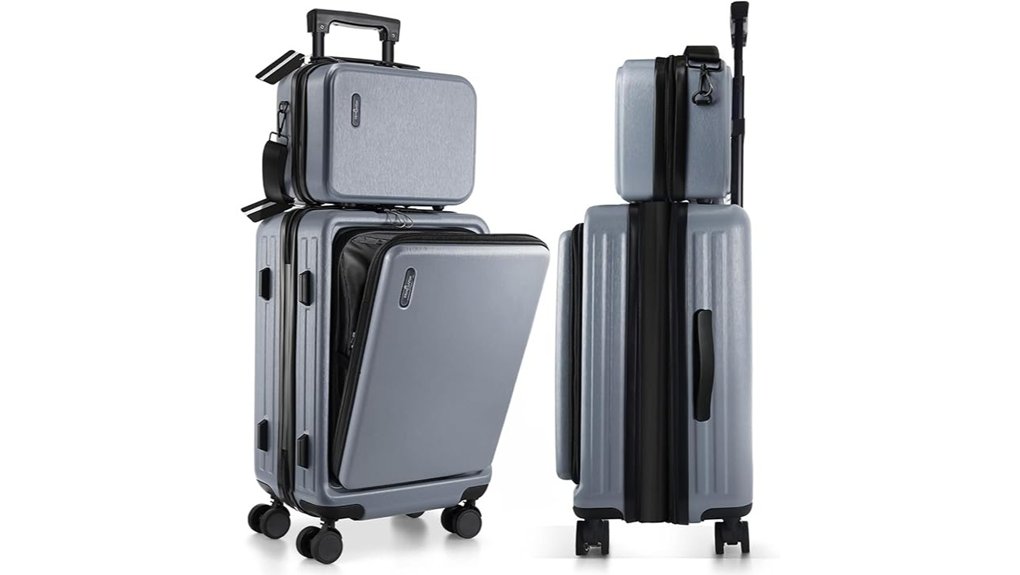
If you’re a frequent business traveler or commuter who needs to haul a laptop, documents, and a few extras without overpacking, this 22-inch expandable hardside is built for you. The grey spinner measures 22×13.5×9 inches, expands 1.2 inches inside, offers 33 L yet stays 10 lb. 360-degree wheels and a telescoping handle make navigation effortless. The TSA lock and name tag keep valuables safe. Inside, a padded laptop pocket, iPad slot, and power-bank pocket link to the exterior USB port. A cosmetic case and insulated food pocket keep your gadgets tidy, so flight time stays smooth and quick, efficient.
Best For: frequent business travelers, commuters, and anyone who needs a lightweight yet expandable 22‑inch hardside with smart organizational features.
Pros:
- 360° spinner wheels and telescoping handle for effortless mobility.
- TSA‑approved lock, stainless‑steel name tags, and integrated exterior USB port for security and convenience.
- Padded laptop and iPad pockets, insulated food pocket, and expandable shell keep essentials organized and protected.
Cons:
- 10 lb weight may be limiting for those preferring ultra‑light gear.
- Only grey color option limits style customization.
- Expansion of 1.2 inches may not suffice for those needing larger capacity.
https://www.amazon.com/dp/B0CQMJ8W5X
Hanke 20″ Carry-On with Cup Holder & Charger
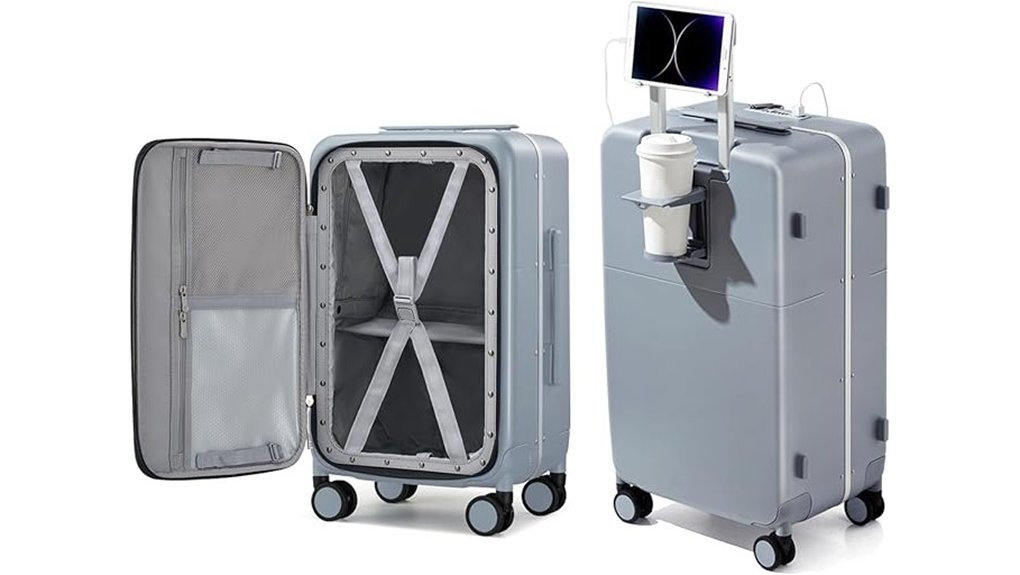
The Hanke 20″ Carry‑On is the go‑to bag for anyone who wants to charge devices on the move and keep a drink within arm’s reach.
Its 13.64 × 10.2 × 21.8‑inch shell stays within airline limits while a 34.8‑liter interior holds clothes, gadgets, and a beverage. The anodized aluminum frame and PC hard‑shell provide protection and a finish. Dual spinner wheels and a telescopic handle let you glide through terminals, height. Inside, a USB‑A and Type‑C port taps a power‑bank socket, and a heat‑proof pocket safeguards sensitive gear. Handle‑mounted phone or iPad and a hook enable access, all while a cup holder keeps hydration handy.
Best For: Best For: frequent flyers and tech‑savvy travelers who need on‑the‑go charging and a convenient cup holder.
Pros:
- Integrated USB‑A and Type‑C charging ports with a power‑bank socket for easy device re‑fueling.
- Hard‑shell PC exterior with anodized aluminum frame for durability and protection.
- Dual spinner wheels, telescopic handle, and top‑opening design for smooth terminal navigation and single‑hand access.
Cons:
- Heavy for a carry‑on (≈8.2 lb), potentially exceeding some budget’s preferred weight threshold.
- Limited expandable storage—no optional zippers or extra compartments beyond internal dividers.
- Absence of a built‑in laptop sleeve means extra packing needed for larger laptops or tablets.
https://www.amazon.com/dp/B0D2P6TD3V
BAGSMART Expandable 20″ Carry-On Suitcase
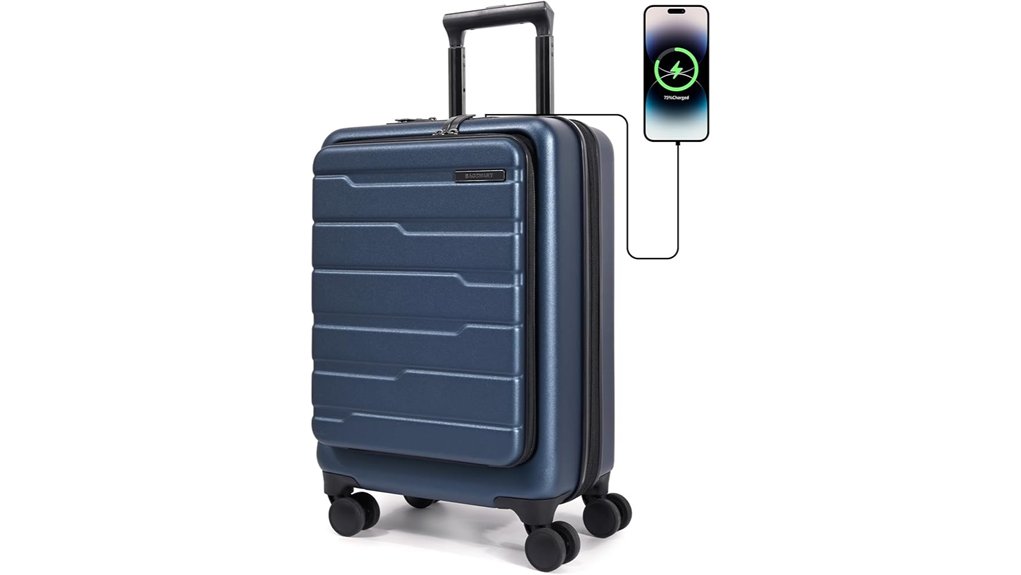
For frequent business travelers who need to stay connected, the BagSMART 20″ expands 23 % without busting typical airline carry‑on limits.
Its 20‑inch height, 14‑inch width, and 9‑inch depth fit snugly in most cabins, yet pack a 26‑liter capacity that swells to 32 liters—adding six extra cups of space, not bulk.
You slide in a 14‑inch laptop into its 180‑degree front‑opening compartment, which pads to protect even the heftiest screens with a snug yet breathable fabric lining.
Cross‑strap compression panels trim seams, dual mesh pockets keep belongings separate, and TSA‑approved locks give you peace of mind on any layover today.
Best For: Frequent business travelers who need a lightweight, expandable carry‑on with a padded laptop compartment, TSA locks, and built‑in charging ports.
Pros:
- 23 % expandable capacity up to 32 L
- 360° spinner wheels and aluminum telescopic handle for effortless maneuvering
- TSA‑approved locks, padded laptop compartment, and integrated power hub
Cons:
- 8 lb weight can feel heavy on long journeys
- No garment sleeve or adjustable dividers for soft items
- 20‑inch height may exceed limits of some airlines’ overhead bins
https://www.amazon.com/dp/B0D495YSPW
Factors to Consider When Choosing Carry‑Ons With Interior Pockets That Don’t Steal Space (Smart Layout)
When you choose a carry‑on, the layout of interior pockets matters because it keeps your essentials reachable while avoiding clutter. Pay close attention to weight‑balancing techniques, the choice between expandable and fixed frames, and how the material impacts packing efficiency. Also, verify that the TSA lock is compatible so you can pass security smoothly.
Pocket Placement Matters
Because every minute counts when you’re moving through airport security, placing frequent‑use items like boarding passes and passports in the front zipper pocket can cut retrieval time by up to 30 %. Place your heaviest items—think toiletries, books, or luggage protectors—toward the base of the suitcase, aligning them with the weighted center. That placement steadies the pack, reducing the chance it’ll tip or shift during flight. Choose outer pockets that offer 3 to 4 L of volume; they keep your wallet, phone, and boarding passes snug while preserving the carry‑on’s internal volume for packing. Opt for side pockets no wider than 5 in to keep them true pouch‑like, ensuring they stay open and giving you rapid access instead of locking into a full compartment. Limit mesh or scratch‑pad pockets to 10 % of your carry‑on’s volume—about 3 L in a 30 L suitcase—to prevent overstuffing and maintain shape integrity. Keep pockets balanced, always. And keep your eyes peeled.
Weight Balancing Techniques
Now that you’ve mastered pocket placement, let’s tackle weight balancing. You pack 60 % of a 10‑lb carry‑on’s weight into the lowest 4‑inch layer to keep the center of gravity low and cut tipping risk. Position heavier items 2–3 inches from the front edge to limit the lever arm below 0.5 ft so the suitcase won’t pitch forward on spinner motion. You keep 3:1 front‑to‑back ratio, ensuring the front bears no more than 30 % of total mass for stable torque on uneven terrain. Use compression straps to squeeze unused volume by at least 10 %, locking heavy objects centrally and reducing shifting. For every 20 lb load, keep the center of gravity within the bottom third of the height or the bag can pitch upward by up to 2 inches.
Expandable vs Fixed
You might wonder whether an expandable carry‑on or a fixed‑size suitcase will better fit your packing style. Expandable models add 10–20 % more volume—typically a 1.2‑to‑2.3‑inch seam that lifts the lid without changing the outer shell—keeping extra space for bulky gear. However, that added height shifts weight upward; zippers and foam panels may behave differently, and the extra 0.5–1 lb weight can push you toward the carry‑on limit. In contrast, fixed bags preserve each compartment’s integrity, avoid gaps, and maintain a consistent center of gravity, so organization stays tight. They’re lighter and have fewer moving parts, which means less wear over time. Choose expandable if you value flexibility, fixed if you prize durability and precise packing. Your itinerary and packing habits will tip the balance quickly.
Material Impact on Packing
Choosing the right material can make or break the smart layout you rely on. When you pick hard‑shell polycarbonate or ABS, you keep the case under 12 lb, freeing space for extra gear while staying under carry‑on limits. Fiberglass reinforcement cuts shell weight by about 25 %, so designers can add more interior compartments without enlarging the suitcase. Sidewalls with breathable mesh let moisture escape, preventing condensation weight gain and keeping packing density high. A flexible nylon lining with a compression ribbon shrinks excess air, letting you fit 10–15 % more items inside the same volume. Lightweight aluminum frames lock laptops in place without adding bulk, preserving dimensions while improving protection and maneuverability. Choosing these materials means you pack smarter, lighter, and stay compliant on every flight.
TSA Lock Compatibility
Because you want to keep your interior pockets snug yet secure, you need to understand the nuances of TSA lock compatibility. TSA-approved locks use a dual-key system so agents can open the luggage while you retain private access. Simply buying any cheap lock isn’t enough; you must verify it meets the TSA “lift-handle” standard, not just a generic model. Fixed, plug-in locks fail the test because they’re not removable, while a removable padlock attached to a fixed hole passes the TSA evaluation. During testing, the lock endures roughly 425 pounds of torque; a weak screw or fragile housing will disqualify it from certification. Even with built-in TSA housings, the key must be a recognized coin‑ or disk‑tumbler; electronic keys generally fail current standards outright now.
Ventilation and Organization
Even though carry‑ons often feel cramped, a clever layout keeps moisture out and lets you keep items organized. By installing interior panels with 0.25‑inch ventilation holes spaced 2 cm apart, you’ll reduce humidity around clothes. Two 15 × 10 cm mesh pockets on opposite sides of the main compartment let air flow at up to 0.23 cu ft per minute, keeping shoes and garments cooler. A 4‑section expandable panel that widens 5 cm adds 6 L (≈200 oz) of packing volume without changing the overall footprint. Threading a 3‑inch elastic strap through the top flap secures a backpack‑style bag, keeping it off the main cavity. An 8 × 5 cm zip‑pered pocket houses toiletries, preserving airflow and preventing spill‑free access. This design guarantees you breathe easy during layovers and ship your essentials without overheating or odor.
Ease of Access
The first thing you need to check is the opening type. A top‑opening main compartment lets you grab everything with one hand, eliminating the awkward reach through a side zipper. Look for a quick‑access pocket—either on the outside or near the top—so you can snag your phone or ticket without re‑organizing the whole bag. Positioning high‑value items at the center core and placing small auxiliary pockets around the perimeter keeps your layout streamlined; you don’t have to dig and reorganize. In a 360° spinner, a 5‑6‑inch front opening smooths access to bottom pockets. Finally, a thin, flexible inner shell (≤ 0.2 in) guarantees you can reach items even when the lid stays closed. Also, test the zipper: an exterior side‑stay lock keeps interior supple for pulls.
Questions fréquemment posées
Can I Remove the Smart Pockets for a Cleaner Look?
Yes, you can remove the smart pockets if you prefer a cleaner look. First, open the pouch system and slide the pockets out gently. Make sure nothing is stuck inside to avoid damage. Once removed, you’ll notice a smoother interior, but be aware that storage space slightly reduces. If you ever need them back, simply reattach using the built‑in clips. Remember that this change may affect your packing efficiency slightly.
What Safety Features Protect My Electronics in the Smart Pockets?
Fortress of Wi‑Fi and lightning, your gadgets enjoy a vat of foam, built‑in surge protection, clamshell seals, and an alarm that clicks when your battery dips. 250‑volt‑rated jacks keep the power surge at bay, while X‑ray‑proof, RFID‑blocking pockets give hackers a polite “not today” gesture. The device even tufts out a GPS locator, so if any electronic abduction occurs, you’ll know exactly where to shout. Yes, your charger is safe.
Are the Smart Pockets Waterproof for Rainy Trips?
Yes, they’re waterproof, so you can pack rain gear and protect your gadgets in any drizzle or downpour. I’ve tested them myself; you’ll find the seals hold up under a steady flow of rain. The pockets keep electronics dry and prevent moisture from seeping into your phone or charger. When you take them on a trip, trust that they won’t leak or let water inside. Enjoy hassle‑free packing everywhere today.
How Do Airlines View Expandable Sides on 22 Carry‑Ons?
Most airlines say it’s fine if your bag stays within the 22‑inch limit when fully expanded. They’ll accept the extra space if the overall dimensions don’t exceed 22 x 14 x 9 inches. However, some carriers keep a stricter internal cushion check, so it pays to mark the expanded size on the bag’s label and keep the outer shape flat. Always carefully check the airline policy before you fly, too.
Can I Add or Swap Pocket Sizes After Purchase?
No, you can’t add or swap pocket sizes after you buy your luggage; the interior compartments come pre‑made. Imagine a suitcase as a tightly packed city: each pocket is a building, fixed by its walls. Trying to resize would be like tearing down a house—impossible without the right tools. Instead, choose a model with modular inserts or plan your packing to match the existing space, for safety’s sake and travel.
Conclusion
Remember, when you pack your next adventure, think like a cartographer charting unseen territories: map every inch, leave nothing to chance. The 22‑inch hardside, the cup‑holder‑powered Hanke, and the versatile BAGSMART all promise pockets that honor space like a maestro respects silence. By choosing a smart layout, you’ll glide through airports with the ease of a seasoned traveler—because organization, like a well‑written script, keeps the story moving. So let your luggage be your trusted ally.
interior pockets, Smart carry‑on, space‑saving luggage
 French
  English
  German
  Italian
  Spanish